
Does Duct Cleaning Lower Energy Bills? The Honest Answer
You have seen the ads: duct cleaning that "pays for itself" in energy savings, sometimes with a suspiciously exact percentage attached. We clean ducts for a living, and we are not going to make that claim. The honest picture has two halves. On the HVAC side, energy savings from duct cleaning are real in specific situations and modest in most. On the dryer side, the savings are direct, measurable in your next load, and often the fastest payback of anything in the house. Here is how the airflow actually works, where the money leaks, and how to spend a cleaning budget so it does the most good.
Why Would a Dirty System Raise Energy Bills in the First Place?
Because every forced-air system is an air-moving machine, and moving air against resistance costs energy. Your blower motor is sized to push a certain volume of air through the ductwork against a certain amount of friction. Anything that adds resistance — a loaded filter, a matted blower wheel, a crushed section of flex duct, a return grille furred over with dust — forces the system to fight for its airflow. What happens next depends on the motor. Older PSC blower motors do not fight back; they simply move less air, so less heating or cooling reaches your rooms and the system runs longer to satisfy the thermostat. Longer runtime is the energy penalty. Newer variable-speed ECM motors do fight back: they sense the restriction and spin harder to hold their airflow target, drawing more watts for every hour they run. Same restriction, different mechanism, same direction on the bill.
The equipment loses ground too. A blower wheel blanketed in dust has blunter, heavier blades that move air less efficiently at the same speed. A dust-coated air conditioning coil transfers heat poorly, so the system needs more minutes of runtime to move the same amount of heating or cooling. None of this shows up as a broken part or an error code. It shows up as a system that runs more hours to do the same job — which is exactly what an energy bill measures.
Does Air Duct Cleaning Actually Lower Heating and Cooling Bills?
Modestly, and mostly indirectly — and we say that as a company that cleans air ducts every day. Here is the uncomfortable physics for our own industry: a thin film of dust on the walls of a rigid metal trunk line barely changes its cross-section. A ten-inch duct with a dust coating is still, functionally, a ten-inch duct. The restrictions that genuinely strain a blower usually live elsewhere — at the filter, on the blower wheel itself, on the coil, at return grilles matted with pet hair, and at supply boots half-buried in debris. That is why no government agency or reputable source publishes a verified, across-the-board percentage for energy savings from duct cleaning, and why we will not quote you one. Be skeptical of any company that does; the same outfits tend to run the $49 "whole-house special" we take apart in our duct cleaning scams guide.
That said, there are real, visible situations where duct-side cleaning helps the energy picture. Construction debris piled in supply boots physically blocks airflow to whole rooms. Return drops matted with years of dust and pet hair choke the intake side of the system, which is the restriction blowers feel most. Crushed or collapsed flex runs and debris left by pests can starve an entire branch. And there is a quieter effect: dirty ducts keep re-loading your filter, so a filter that should last three months loads up early and starts strangling airflow ahead of schedule. Duct cleaning does not change your duct diameter — it removes the debris and the dust reservoir that feed the true choke points.
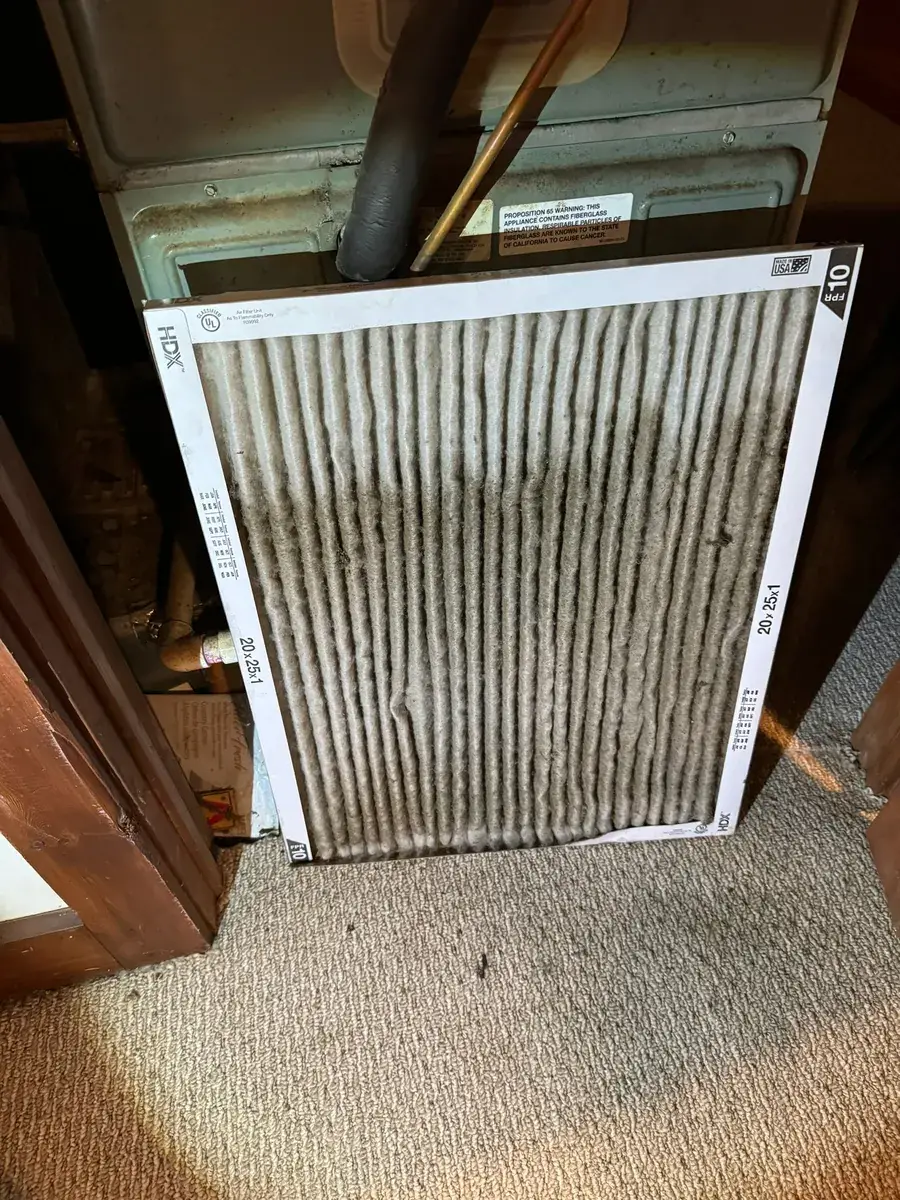
The filter is the real choke point
If your only goal is a lower heating and cooling bill, start with the cheapest part in the system. A loaded filter is the single most common airflow restriction we find, and replacing it costs a few dollars and five minutes. No cleaning service beats that math, and any honest company will tell you so.
Where the duct system comes back into the story is upstream of that filter. When the return side is coated in buildup, every new filter starts loading from day one. During our free video inspection we show you what the return runs actually look like inside, so you can see whether your ducts are feeding the problem or just carrying air. That inspection-first approach is the core of our process — we prove the condition before we recommend anything.
Where Are the Savings Real? Look at Your Dryer Vent
A clothes dryer is the appliance where cleaning translates to energy savings you can measure in your own laundry room, without trusting anyone's percentage. The mechanism is blunt: drying is an exhaust process, and every ounce of water in a load has to leave the house as vapor through one pipe. When lint narrows that pipe, moist air backs up in the drum, evaporation stalls, and the load comes out damp. So you run it again — and a second cycle costs exactly as much as the first. Two cycles per load means roughly double the drying energy per load, week after week. There is no vague multiplier to argue about; you are literally paying for every load twice.
Put example numbers on it, then check them against your own bill. A typical electric dryer uses somewhere around 3 to 4 kilowatt-hours per full cycle. At an example rate of 17 cents per kilowatt-hour, a second 3.5 kWh cycle adds roughly 60 cents to every load. A household running six to eight loads a week is wasting something in the neighborhood of $180 to $250 a year — typically more than a professional dryer vent cleaning costs, which means the fix usually pays for itself inside a year on electricity alone, before counting the hours of your time and the doubled wear on the machine. And because we give you a flat, written quote after a free video inspection — before any work begins — you can run that payback math with a real number in hand instead of a guess. Our article on why clothes take two cycles to dry walks through the full mechanics and a load-by-load cost table.

The waste and the risk share one cause
The same lint that doubles your drying cost is also the fuel for the most preventable fire in the house. Lint is dry, fibrous, and finely divided, and a restricted vent concentrates heat exactly where it collects. Slow drying is the polite early warning.
So the energy argument and the safety argument point at the same fix: keep the exhaust run clear from the dryer connection to the exterior termination. Our dryer vent fire safety guide covers the warning signs and prevention habits in depth.
Where Does Cleaning Help Your Bill — and Where Doesn't It?
Here is the whole article in one honest table. "Real" means you can expect a measurable difference when the condition exists; "modest" means clean it for other reasons and treat any energy benefit as a bonus.
| Where the energy goes | What restricts it | How real the savings are |
|---|---|---|
| Dryer vent run | Lint narrowing the exhaust line, forcing second cycles | Real and measurable — doubled cycles are doubled cost, and a professional cleaning typically pays for itself within the year |
| HVAC filter | Dust load choking the system's main intake point | Real — and it is a DIY fix that costs a few dollars on schedule |
| Blower wheel and AC coil | Matted dust blunting blades and insulating the coil | Real, but this is HVAC equipment service, not duct cleaning — know what you are buying |
| Return grilles and return drops | Pet hair and dust matting the intake side; buildup re-loading each new filter | Moderate — the return side is the restriction blowers feel most, and it is part of a proper duct cleaning |
| Duct interior surfaces | A thin dust film on the walls of full-size trunk lines | Modest — clean it for debris, air quality, and dust control, not for the bill |
| Blocked boots, crushed flex, nests | Debris physically starving individual rooms or branches | Real when present — a video inspection shows you whether you have them before you pay |
What Should You Check Before Paying Anyone to "Cut Your Bills"?
Run through this list first. It is ordered from free to flat-rate, and it will either solve the problem cheaply or tell you exactly which service you actually need:
- Replace the HVAC filter and set a schedule. The most common airflow restriction in any house is also the cheapest fix. If a fresh filter noticeably improves airflow at the registers, you just found your first answer.
- Open and uncover every register and return. Furniture over a return or closed supply dampers force the blower to work against restriction you created for free.
- Pull the dryer out and check the transition hose. A foil hose crushed against the wall is a restriction no cleaning fixes — straighten or replace it.
- Watch the exterior dryer flap while a load runs. A flap that barely moves means weak exhaust airflow, and the restriction is somewhere in the run.
- Track your dry times. Loads creeping from one cycle toward two is the clearest energy-waste signal in the house, and it will not fix itself.
- Demand proof, not promises. Whoever you hire, insist on before evidence (video inspection) and after evidence (photos, restored airflow) — never a percentage promise on your energy bill.
When Is Duct Cleaning Clearly Worth It, Even If Energy Isn't the Reason?
When there is something in the ducts that should not be there. Visible mold growth, heavy debris, evidence of mice or birds, and renovation dust are the cases where air duct cleaning earns its keep regardless of what it does to your utility bill — you are removing contamination from the pathway every breath of conditioned air travels through. Many homeowners also notice less dust settling on furniture and some relief from that stale, dusty smell when the system kicks on. We keep health claims measured because that is what the evidence supports: duct cleaning can help reduce the dust and debris circulating through the system, and it is clearly warranted when buildup is visible. If you are not sure your ducts qualify, our guide to the signs your air ducts need cleaning gives you an honest checklist — and the free video inspection settles it with your own eyes before any work starts.
Whatever your system turns out to need, you will know the cost before we touch a tool. Every job starts with a free video inspection, and you receive a flat, written quote before any work begins — routine cleaning and deep cleaning are scoped honestly as different services, so you are never quoted one and sold the other. There are no trip fees anywhere in our service area, no surprise invoice, and no door-step upsell. Financing is available through Wisetack, and as a Google Guaranteed company, your money is protected up to $2,000 under Google's program. E Cleaning is a family-owned, PA-licensed contractor (PA 187935), insured up to $2 million, serving Montgomery, Chester, Bucks, Delaware, Berks, and Philadelphia counties from King of Prussia, around the clock, Sunday through Friday.
