
Dryer Vent Safety: Codes, Standards and What Inspectors Look For
Most people never think about the pipe behind the clothes dryer until a home inspector, an insurance question, or a slow-drying load of towels forces the issue. Yet the dryer exhaust is one of the few appliance connections that residential building codes address in real detail — because when it is built wrong, it does not just waste energy, it stockpiles fine fuel next to a heat source. Here is what IRC-based codes generally require, why the shiny foil duct sold in every hardware store fails the standard, and what inspectors actually look for when a house changes hands.
What Does Residential Code Require for a Dryer Vent?
Nearly every municipality in southeastern Pennsylvania bases its residential rules on the International Residential Code, and while local amendments vary — your local code office always has the final word — the fundamentals of a compliant dryer exhaust system are consistent:
- It terminates outdoors. Never into an attic, crawlspace, garage, or soffit cavity — the moist, lint-loaded air has to leave the building entirely.
- The concealed run is rigid, smooth-interior metal duct, typically 4 inches in diameter.
- Joints fit in the direction of airflow and are secured with clamps or foil tape — no screws or fasteners protruding into the airstream.
- The exterior termination has a backdraft damper — and no screen or mesh over the opening.
- The total run stays within the code's length allowance, with every bend deducted from it.
- The connector behind the dryer is a short, listed transition duct, kept exposed — never buried in a wall, floor, or ceiling.
- The duct serves the dryer alone. It is never shared with a bath fan, range hood, or any other exhaust.
Two of those rules surprise homeowners most. The no-screws rule exists because every screw tip that pokes into the airstream becomes a lint anchor: fibers snag on it, the snag becomes a tuft, the tuft becomes a mat, and the mat becomes the start of a clog. The no-screens rule exists for the same reason — mesh fine enough to stop insects is fine enough to catch lint, and a screened cap can choke an otherwise perfect run in a single season. Smooth interior, smooth joints, unobstructed exit: the entire code philosophy is that nothing should give lint a place to stop.
How Long Can a Dryer Vent Run Be?
IRC-based codes cap the total developed length of the run — around 35 feet is the widely used baseline — and every fitting spends part of that allowance, with a sharp 90-degree elbow costing the most. That is why a vent that looks short on paper can still be over the limit: a basement laundry that jogs around a beam, rises through a wall, and elbows twice more before reaching the rim joist has burned through much of its allowance before it travels ten straight feet. Two paths legitimately extend the limit: a dryer whose manufacturer's installation instructions are rated for a longer run, and a listed booster fan installed per its listing. Both are exceptions you document, not assumptions you make.
The length limit is not bureaucratic fussiness — it is airflow physics. Every added foot and every bend slows the exhaust stream, and the moment moist air slows, lint falls out of suspension and settles. Long runs and elbow-heavy runs clog sooner and need attention more often; our guide to how often you should clean your dryer vent explains how run length and household laundry volume set the right interval for your home.
Why Does Foil Accordion Duct Fail Inspections?
Because it violates the code's core idea — a smooth, snag-free path — by design. Foil accordion duct (the shiny "slinky" product in every hardware aisle) gets its flexibility from a spiral wire wrapped in thin foil, which gives the interior deep, regular ridges. Every ridge is a shelf where lint lands; every kink and sag is a low spot where it collects. The material also crushes with a light push and tears along its ridges, so the section behind the dryer — flattened every time the machine is shoved back against the wall — is usually the worst spot in the entire system. Vinyl and plastic flex duct is worse still: it is not just a lint trap, it is combustible, and it has no business anywhere on a clothes dryer.
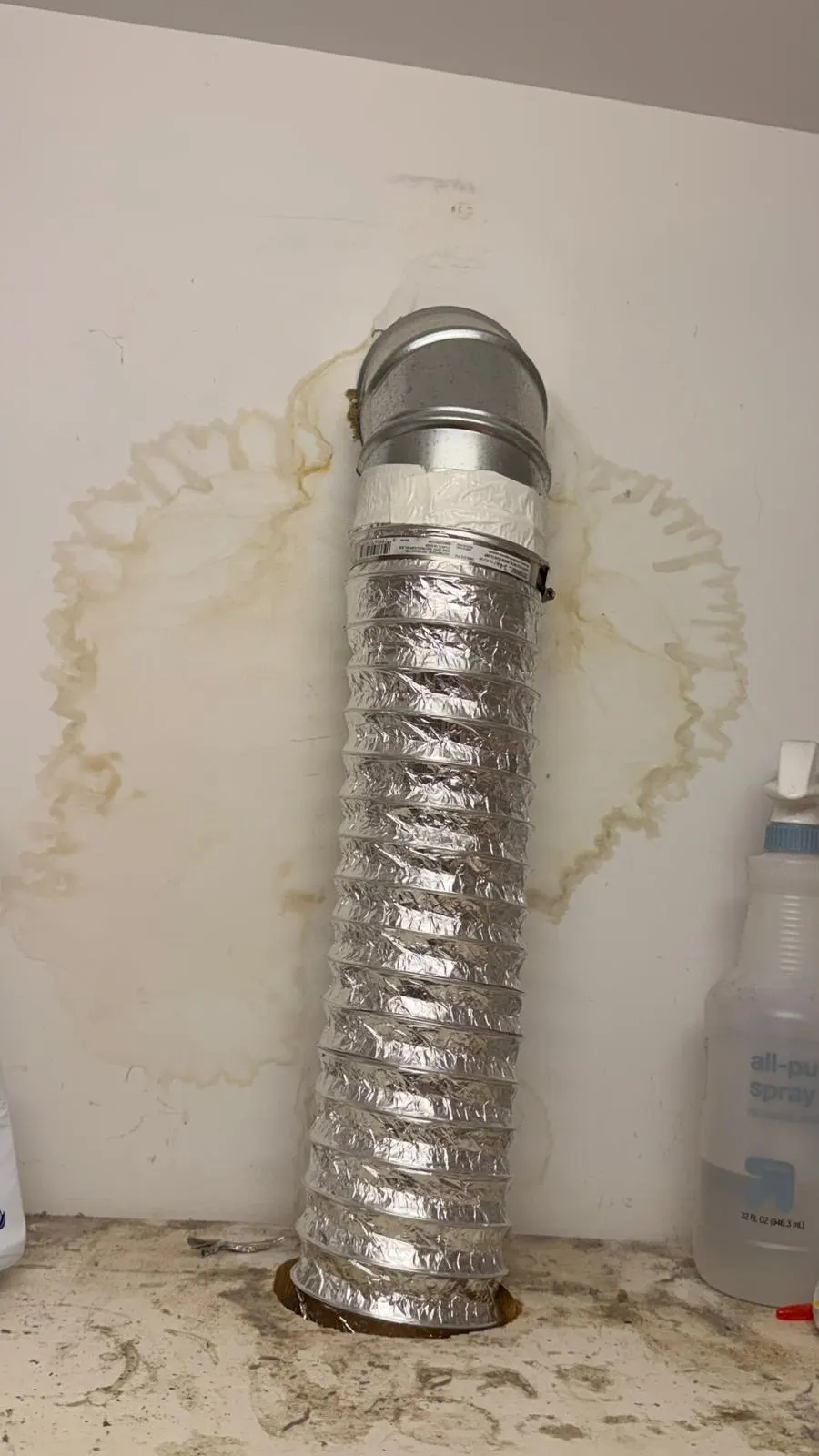
The section inspectors flag first
This worn, stained transition duct is typical of what sits behind a dryer that has not been pulled out in years. Accordion-style duct in this condition gets written up on sight: the ridged interior is loaded with lint, the crush marks restrict airflow, and foil this fatigued tears the next time the machine moves.
The fix is not a cleaning — it is a swap to a listed semi-rigid metal connector, kept short and unkinked. It is one of the fastest upgrades in the whole system, and it removes the exact segment where most clogs are born.
| Material | Interior surface | Where codes allow it | Inspection verdict |
|---|---|---|---|
| Rigid galvanized steel or aluminum duct | Smooth | The full concealed run, laundry wall to exterior termination | The standard — this is what passes |
| Semi-rigid aluminum connector (UL 2158A listed) | Lightly ribbed | Short, exposed transition behind the dryer only | Acceptable as a transition; flagged if buried in framing |
| Foil accordion "slinky" duct | Deeply ridged over spiral wire | Effectively nowhere in a modern installation | Flagged — traps lint, kinks, crushes, tears |
| Vinyl or plastic flex duct | Ridged and combustible | Nowhere on a clothes dryer | Automatic write-up — replace immediately |
What Should the Exterior Termination Look Like?
A clean cap with a damper that swings freely — nothing more, nothing less. The backdraft damper opens under the dryer's airflow and falls closed when the machine stops, keeping cold air, rain, and pests out without giving lint a surface to build on. Code-minded installers also keep the termination clear of the ground and away from other building openings so the moist exhaust does not get drawn back inside — exact clearances vary locally, so treat placement as a check-with-your-code-office detail. What never belongs there is a screen. If birds or rodents are the worry, the answer is a guard designed for dryer terminations, which keeps the opening protected and cleanable — not window mesh zip-tied over the hood.
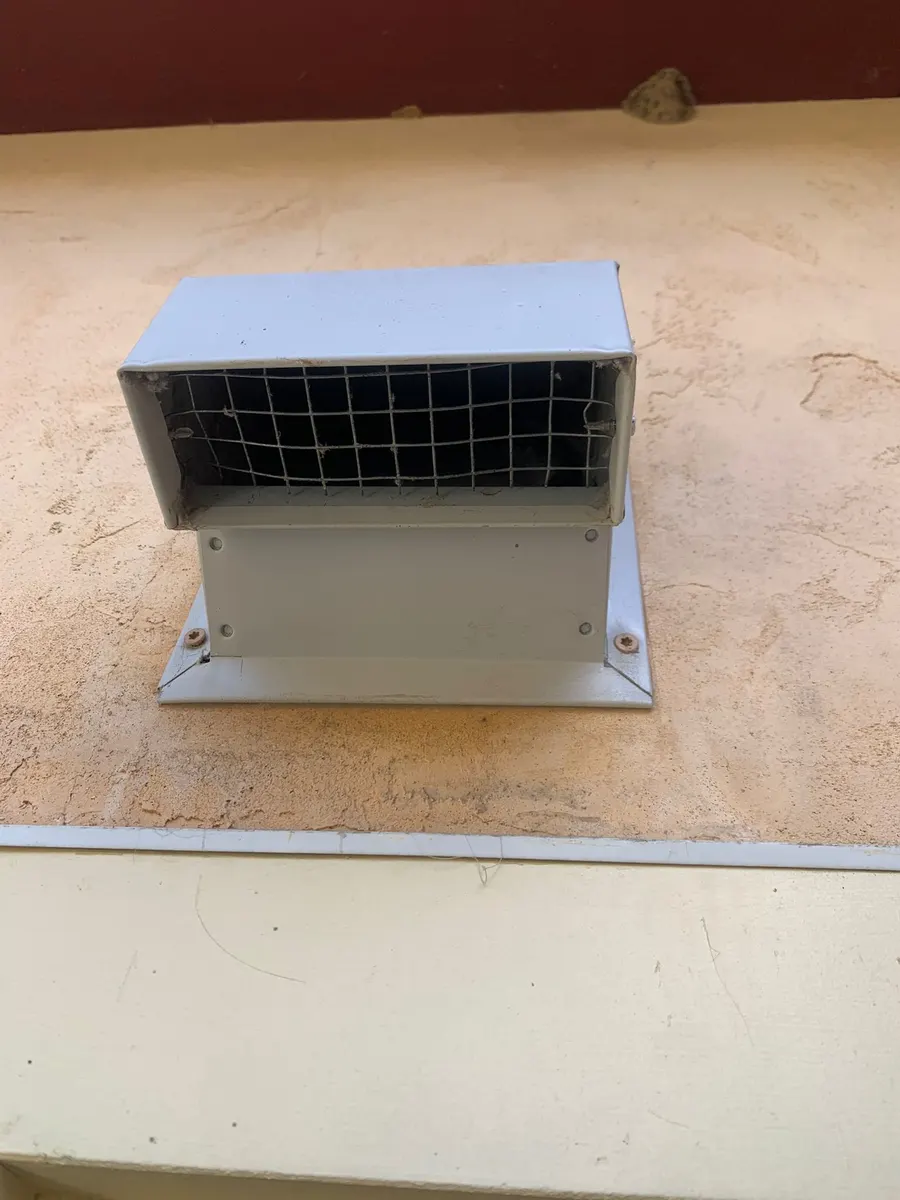
A thirty-second self-check
Compare this clean termination with the lint-choked one at the top of this article — both are real job photos. Yours should look like this one: louvers that sit flush, no lint beard around the opening, and a flap that lifts visibly when the dryer runs.
Start a load, walk outside, and watch the cap. Strong, steady airflow and a freely swinging damper are the single best quick indicator that the whole run is healthy. A flap that barely moves means the line is restricted somewhere you cannot see.
That is the stake behind every rule on this page. Material, length, joints, and termination requirements all exist to keep lint moving out of the house instead of accumulating inside a heated appliance connection. Our dryer vent fire safety guide covers the warning signs that should stop you from running another load.
What Do Home Inspectors Flag During a Sale?
Dryer vents are a reliable line item in pre-sale inspection reports because the problems are visible without opening walls. The classics: foil or vinyl duct anywhere in the system, a lint beard at the exterior cap, a damper flap that is stuck, rusted, or missing, and a crushed transition behind the machine. Inspectors also note terminations in the wrong place — exhaust dumping into a crawlspace, attic, or garage instead of outdoors — along with visibly excessive runs, joints held together with protruding screws, screened caps, and the telltale evidence of a disconnected duct: lint film on basement framing or a musty, humid laundry area.
A home inspection is not a municipal pass/fail, but the write-up lands in the report, and buyers treat safety items differently from cosmetic ones — a flagged dryer vent routinely becomes a repair request or a credit negotiation. The frustrating part for sellers is how small the underlying fix usually is. A professional dryer vent cleaning plus a transition-duct swap resolves the majority of flagged items in a single visit, and handling it before listing means the report notes a serviced system instead of a deficiency.
When Does Replacement Beat Cleaning?
Cleaning fixes buildup inside a sound, code-friendly duct; replacement fixes the duct itself. If the camera shows rigid metal that is intact but lint-loaded, cleaning restores it completely. But when the material is wrong, cleaning is a patch at best: foil accordion duct re-collects lint on its ridges almost immediately, and fatigued foil often will not survive proper rotary agitation anyway. The same logic applies to crushed sections, torn flex, separated joints, and terminations that dump into the wrong place — no amount of brushing un-crushes, reconnects, or re-routes anything.

What the camera decides
This pile came out of a single residential line. When buildup like this sits inside sound rigid duct, a deep cleaning is the whole fix. When it sits inside foil accordion duct, extraction alone is a short-term reprieve — the material that trapped it is still there, ready to start over.
That judgment call — clean it, replace it, or both — is exactly what the free video inspection settles before you commit to anything. Our breakdown of dryer vent repair vs cleaning walks through every symptom pair in detail.
How Do You Bring a Dryer Vent Up to Standard?
Start by finding out what you actually have, because most of the run is hidden. Every E Cleaning dryer vent job starts with a free video inspection: a camera goes into the line and you see the material, the buildup, and any damage on screen before deciding anything. Then you get a flat, written quote for exactly the work the camera justified — a routine cleaning on a sound line, a deep cleaning, a transition swap, or a material upgrade — before any work begins. No surprise invoice, no door-step upsell. You can read the step-by-step on our process page.
The work is backed the way code-minded work should be: E Cleaning is a PA-licensed contractor (PA 187935), insured up to $2 million, rated 4.8 stars across 144 Google reviews, and every job carries a 6-month workmanship warranty — if a problem traced to our work shows up within six months, we come back and make it right free. We are also Google Guaranteed, Google's own program that provides money-back protection up to $2,000 on qualifying jobs. We serve Montgomery, Chester, Bucks, Delaware, Berks, and Philadelphia counties from King of Prussia, and we are open 24 hours a day, Sunday through Friday — closed Saturdays.
