
Duct Cleaning Before and After: What Clean Actually Looks Like
Before-and-after is the most honest way to judge a duct cleaning, because all of the work happens where you cannot see it. Every photo in this article comes from real E Cleaning jobs across Montgomery, Chester, Bucks, and Delaware counties — the same documentation you get on your own system, since we run a video inspection inside the ducts before we start and hand over after-photos when we finish.
What do air ducts look like before cleaning?
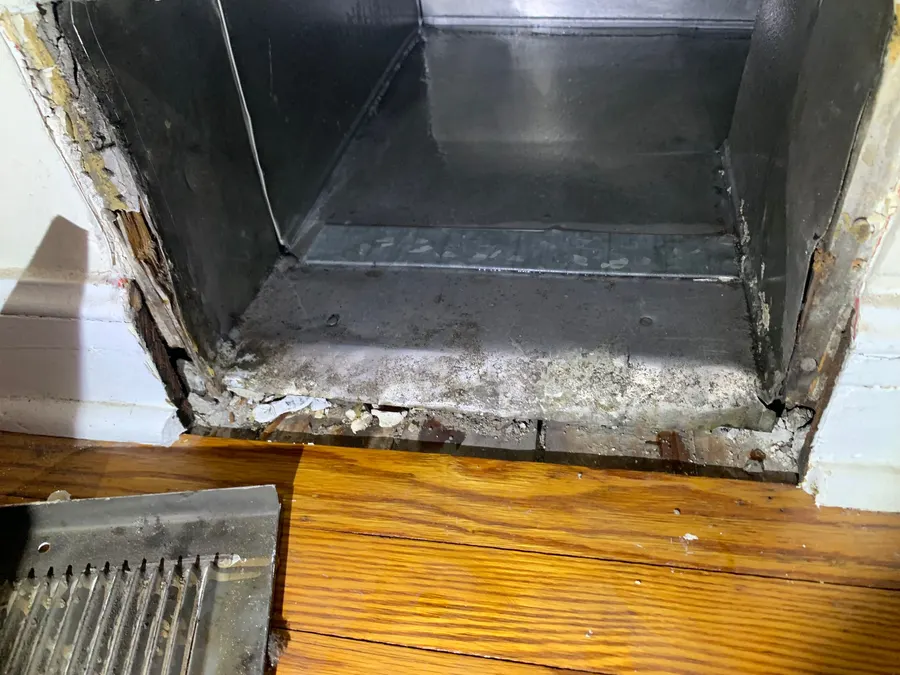
Inside a system that has gone years without cleaning, the duct walls stop looking like metal at all. Fine dust settles first, then hair, dander, and fibers knit into it, and the blower packs each new layer down. The result is a grey, felt-like lining that coats the walls of the runs and collects in drifts along the bottom of the trunk lines. In round branch ducts, the buildup narrows the effective opening; in floor boots, it mixes with crumbs, pet hair, and whatever has fallen through the register over the years.

The photo above is a typical starting point — not a horror story, just an ordinary duct that was never opened. Homes with shedding pets, recent renovations, or decades of deferred cleaning look considerably worse. If you want to know whether your own system is in this condition, our guide to the signs your air ducts need cleaning walks through what you can check yourself with a flashlight and a screwdriver.
What does a real before-and-after pair look like?
A legitimate before-and-after pair shows the same section of your ductwork, from the same angle, on the same day — buildup in the first frame, bare metal in the second. Drag the handle on the comparisons below to see two real examples from our jobs. The first is a main trunk line, the large rectangular duct that feeds every branch run in the house.


Notice what changes and what does not. The felt-like lining and the drifts of debris are gone, and you can see the galvanized sheet metal, the seams, and the screw tips that were buried before. The duct itself — its dents, its joints, its age — is unchanged. That is what honest work looks like.


The second pair is a round branch run — the kind that feeds an individual room. Before cleaning, the caked walls were effectively shrinking the pipe. After cleaning, the full diameter is open again, which is exactly why rooms at the end of long runs often feel the difference first.
What does "clean to bare metal" actually mean?
Clean to bare metal means the buildup is physically removed from the duct walls, not loosened and left behind — you can see the metal surface, its seams, and its fasteners again. The method that achieves this is called source removal, and it is the approach NADCA sets as the industry standard.
Here is how we get there. Our technicians connect a professional Nikro negative-pressure machine to the trunk line, putting the entire duct system under vacuum. Then compressed-air whips and agitation tools travel through every run, knocking the compacted buildup off the walls while the negative pressure pulls the loosened debris back to the machine and through HEPA filtration — instead of into your rooms. Registers and grilles come off and get cleaned separately.
Two honest caveats. First, flex duct — the wire-and-plastic ribbed ducting common in attics and newer additions — has no metal to bare. Clean flex duct means the liner is free of buildup, cleaned with gentler agitation so the liner is not torn. Second, bare metal does not mean factory-new. Surface rust marks, old water stains, adhesive residue, and dents are permanent features of a duct, not dirt. Cleaning removes buildup; it does not restore metal. An after-photo of a 40-year-old system that looks showroom-perfect should raise questions, not confidence.
How can you tell an after-photo is honest?
After-photos are only worth something if they can be matched to your house and your before-photos. This is the accountability step most homeowners never think to ask about — and the one that separates documented work from a wave goodbye. A legitimate photo set has these traits:
- Same duct, same angle — the after-shot repeats the before-shot so you can compare like for like
- Interior views, not just registers — a washed grille proves nothing about the fifty feet of duct behind it
- Recognizable details — seams, joints, dents, or markings that confirm it is your ductwork, not a stock photo
- Taken the same day — before the crew starts and after they finish, on your job
- Imperfections left visible — permanent stains and rust still there, because honest photos are not retouched
- Delivered to you — you keep the photos, not just a verbal all done
We build this into every job: the free video inspection before any work begins shows you the inside of your own ducts on camera, and the after-photos close the loop when the work is done. You can see exactly where those steps fall in the visit on our process page. It is also your best defense against the $49 whole-house special crowd, whose business model depends on you never seeing inside the ducts at all.
What differences do homeowners notice after duct cleaning?
The changes homeowners report most often are practical ones: airflow, smell, and dust. Where compacted buildup was restricting a branch run, removing it reopens the full diameter of the pipe, and rooms at the end of long runs often feel noticeably stronger supply air. The musty smell some systems exhale in the first minutes after startup — air passing over a reservoir of settled dust — tends to fade once that reservoir is removed. And filters that had been loading up in a few weeks typically go back to a normal one-to-three-month life, because the return side is no longer carrying years of loose dust.
A measured note is in order. The EPA does not endorse routine duct cleaning as a proven fix for indoor air quality, and no honest company should promise it will cure allergies or cut your energy bill by some specific percentage. What cleaning verifiably does is remove the settled dust, dander, and debris your system was recirculating — the before-photos show it was there, and the after-photos show it is gone. Many homeowners notice the difference; the cases where cleaning is clearly warranted are visible mold, heavy debris, pest activity, and renovation dust.
Before vs after: what should change, checkpoint by checkpoint
Use this table as your inspection sheet. These are the spots our cameras and photos document on a typical job, what they look like beforehand, and what the after-photos should show.
| Checkpoint | Typical before | What after should look like |
|---|---|---|
| Main trunk lines | Felt-like grey lining, drifts of debris along the bottom | Bare sheet metal, seams and fasteners visible |
| Round branch runs | Caked walls narrowing the opening | Full diameter open, walls clean |
| Supply boots | Crumbs, hair, toys, construction debris | Vacuumed clean down to the boot |
| Return drops | Matted dust, pet hair pulled in from rooms | Clear, no loose material |
| Registers and diffusers | Dust streaks, dark spotting around vanes | Removed, washed, and reinstalled |
| Flex duct sections | Buildup clinging to the ribbed liner | Liner free of buildup, undamaged |
| Permanent marks | Rust stains, dents, adhesive residue | Still visible — cleaning removes dirt, not history |
Does dryer vent cleaning have a before-and-after too?
Yes, and it is often more dramatic than the ductwork. A clogged dryer vent gives up a pile of compacted lint — sometimes a grocery bag full from a single run — and the exterior hood goes from choked with grey fuzz to fully open. Because lint is fuel, this is the before-and-after with real safety stakes: the NFPA identifies failure to clean as the leading factor in home dryer fires, a topic we cover in depth in our dryer vent fire safety guide.
Most customers bundle dryer vent cleaning with a duct job since the crew is already on site, and it comes with the same photo documentation of the cleared vent and hood. Ask when you book, and the vent is simply added to the same flat, written quote you approve before the crew starts.
What does documented duct cleaning cost?
With us, the cost works the same way the photos do: nothing is decided until you have seen the evidence. Every air duct cleaning starts with a free video inspection, and what the camera finds sets an honest scope — routine cleaning and deep cleaning are quoted as the different services they are. You then get a flat, written quote before any work begins, with no trip fees anywhere in our service area, no surprise invoice, and no door-step upsell; financing is available through Wisetack. The quote covers the source-removal cleaning with Nikro negative-pressure equipment and agitation tools, and the after-photos this article is about. E Cleaning is family-owned, serving the Philadelphia suburbs since 2016, PA licensed (PA 187935), insured up to $2 million, and Google Guaranteed with money-back protection up to $2,000 on qualifying jobs.
If the camera shows your ducts are already clean, we will tell you that and pack up — the inspection costs you nothing either way. That is the point of before-and-after documentation: nobody has to take anybody's word for anything.