
Duct Cleaning in Older Greater Philadelphia Homes: What's Different
Older homes need a different approach to duct cleaning. Around Greater Philadelphia, ductwork in pre-war and mid-century houses was usually retrofitted or has run for decades: mixed materials, odd routing, panned joist returns, and far heavier accumulation. That calls for a camera inspection first, gentler source removal, and honest asbestos awareness — we never disturb suspect materials.
The housing stock around Philadelphia is among the oldest in the country. Drive through Ardmore, Media, Jenkintown, or West Chester and you pass stone colonials and twins built before central air conditioning existed; turn a corner and you are in a 1950s neighborhood of brick colonials and split-levels from the first big wave of ducted forced-air heat. Almost none of these houses were designed around the duct systems they run today. The ducts were squeezed in later, or they have been doing the same job since the Eisenhower administration.
E Cleaning is based in King of Prussia, and older homes make up a large share of our daily work across Montgomery, Chester, Delaware, and Bucks counties. Every job starts with a free video inspection inside the ducts, so before we clean anything, we — and you — see exactly what eighty or a hundred years of house life looks like from the inside. Here is what makes these systems different, what we watch for, and where we draw a hard line for your safety.
Why is duct cleaning different in an older home?
Three reasons. The ductwork was rarely designed for the equipment it now serves; the materials and routing vary wildly within a single house; and the accumulation inside is measured in decades, not years. A newer suburban home has predictable trunk-and-branch sheet metal with flex takeoffs. An older Greater Philadelphia home can have converted gravity-furnace ducts in the basement, panned joist returns under the floors, duct board from a 1970s upgrade, and flex duct from a 1990s attic retrofit — all feeding the same air handler.
None of that makes an older system uncleanable. It means the cleaning has to be planned around what is actually there, which is exactly why we put a camera inside first instead of quoting blind over the phone. The method itself — source-removal air duct cleaning under negative pressure — stays the same; the tooling, agitation, and access points change house by house.
What do we see in pre-war Main Line stone homes?
Houses built from roughly 1900 to 1940 — the stone colonials, Tudors, and twins of the Main Line, Chestnut Hill, and the older boroughs — were originally heated by radiators or gravity furnaces, not by the ducted systems most of them run now. When forced air arrived decades later, installers had to work around thick stone walls and plaster ceilings that do not forgive mistakes, so ducts went wherever they could: up through closets, boxed into chase walls, and along the ceilings of fieldstone basements in long horizontal runs.
Two patterns show up again and again. First, converted gravity systems: the old coal-fired "octopus" furnace moved air by convection through enormous round ducts, and when a modern furnace replaced it, those oversized runs were often reused. They work, but they move air at low velocity, which lets dust settle and build in layers instead of staying carried in the airstream. Second, everything the house has lived through is still in there — coal-era soot, plaster grit from a century of settling and repairs, and the dust of every renovation the house has ever seen. If the ducts have never been professionally cleaned, nothing has ever taken it out.
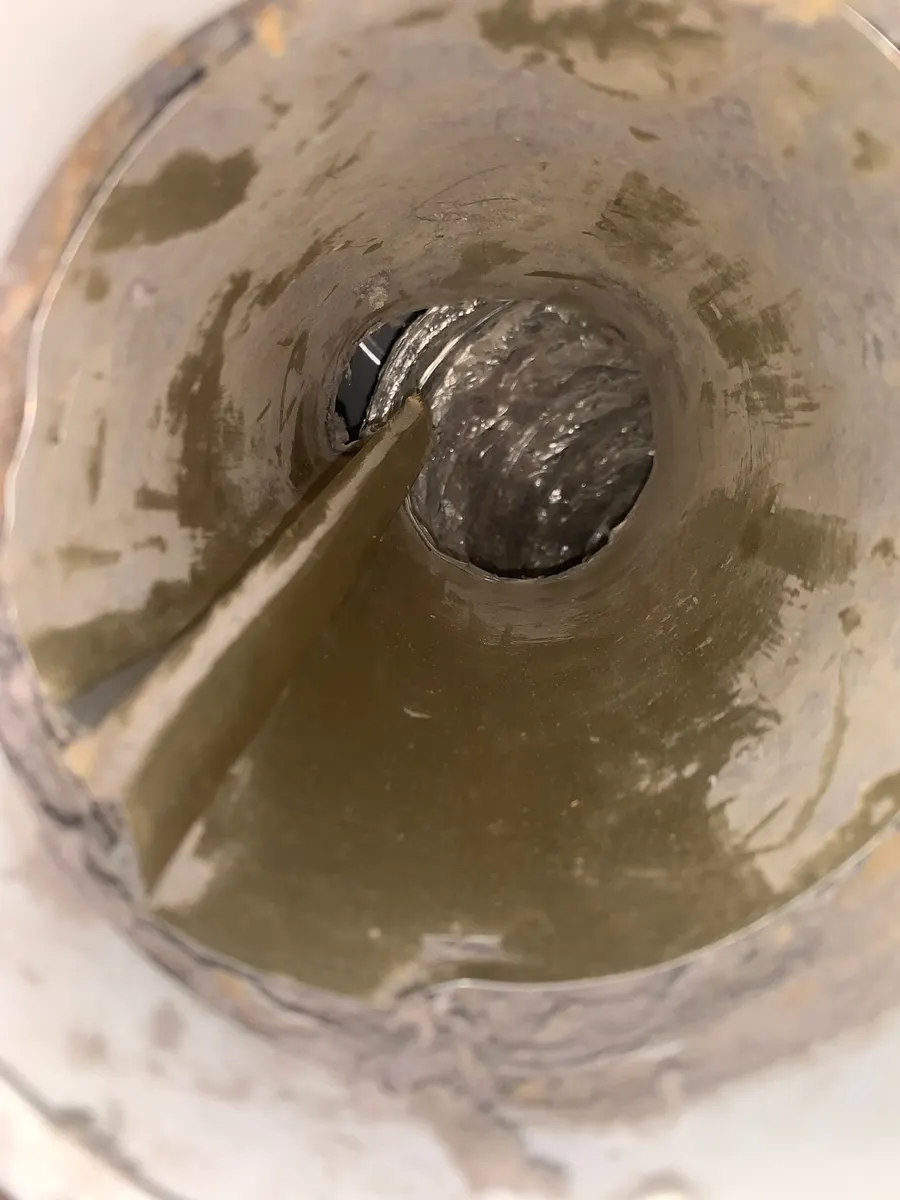
Low velocity, high accumulation
This is the inside of a round metal duct with years of layered buildup — the pattern we routinely find in older, oversized runs. Dust bonds to the slight humidity and oil film on the metal, each layer gives the next one something to grip, and the effective diameter of the duct shrinks year by year. Buildup like this does not respond to a shop vac held at the register. It takes negative pressure on the whole run plus mechanical agitation to break the layers loose and pull them out to a HEPA-filtered collector.
What is different about mid-century colonials and split-levels?
Post-war neighborhoods — the Levittown sections of Bucks County, and the split-levels and ranches that filled in Delaware and Montgomery counties through the 1950s and 60s — were the first generation of local housing built around ducted forced-air heat from day one. That is good news for layout: the trunk lines run where a designer intended. The catch is age. Original sheet-metal ductwork in these homes is now sixty to seventy years old, and much of it has never been opened, sealed, or cleaned since installation.
The signature mid-century quirk is the panned joist return: instead of running dedicated return duct, installers nailed sheet metal across the underside of open floor-joist bays and used the cavity itself as the return path. It saved material, and it worked — but a wood-and-metal cavity is not a sealed duct. Panned returns pull in basement dust, insulation fibers, and anything else sitting in the joist bay along with the house air, and they collect debris everywhere the airflow slows down. When we inspect a mid-century system, the returns are usually dirtier than the supplies.
| Home era | Typical duct setup | What we watch for |
|---|---|---|
| Pre-war (before 1940) | Retrofitted forced air; converted gravity-furnace runs; ducts boxed into closets and chases | Oversized low-velocity ducts, coal-era soot and plaster grit, fragile joints, asbestos-era wraps and tapes |
| Mid-century (1945–1970) | Original trunk-and-branch sheet metal; panned joist returns; floor registers | Six decades of accumulation, leaky panned returns, rusted floor boots, asbestos-era tape at joints |
| 1970s–1980s | Duct board sections; early flex duct; add-on central air | Softer materials that need gentler agitation; crushed or sagging flex runs |
| 1990s and newer | Sheet metal trunks with flex branches | Standard cleaning; occasional construction debris — see our post-renovation guide |
Which retrofit quirks do we run into most often?
Any house that gained central air or new heat after it was built carries the fingerprints of that retrofit. These are the ones that change how we plan a cleaning:
- Panned joist returns — open joist cavities used as return ducts; leaky, dusty, and always on the inspection list.
- Mixed materials in one system — bare metal, duct board, and flex in a single loop, each needing different agitation tools.
- Attic and crawlspace runs from later air-conditioning additions, where flex duct sags, kinks, and collects debris at every low spot.
- One big central return instead of returns in every room — it handles the whole house's air and loads up far faster.
- Rusted or debris-filled floor boots — floor registers collect decades of dropped items, from toys to hardware to felted pet hair.
- Abandoned dead-end runs from past remodels that still connect to the system and quietly stockpile dust.
- Small-duct high-velocity retrofits in houses that could not fit conventional duct — these need their own assessment, which is exactly what the camera inspection is for.
What about asbestos? An honest answer
If your home was built before about 1980, materials on or near the ductwork can contain asbestos: white or gray insulation wrap on trunk lines, fabric tape sealing duct joints, and vibration-damper collars at the furnace are the common suspects. Here is our policy, stated plainly: we do not disturb suspect materials, period. We are a duct cleaning company, not an asbestos testing lab or an abatement contractor, and no visual guess — ours or anyone's — can confirm what a material contains.
If our walk-around or camera inspection turns up wrap, tape, or board that looks like an asbestos-era material, we stop, show you what we found, and recommend testing by a certified asbestos inspector before any work that could touch it. If testing comes back clear, we proceed normally. If it confirms asbestos, licensed abatement comes first and cleaning comes after. What we will never do is agitate, cut, or vacuum around suspect material and hope for the best — undisturbed asbestos in good condition is generally best left alone, and disturbing it is exactly the wrong move. Any company willing to blast away next to a flaking duct wrap to keep an appointment on schedule is not a company you want in your basement.
What does decades of accumulation actually look like?
Heavier and stranger than most homeowners expect. In a house that has run forced air since the 1950s without a cleaning, we find layered dust in every slow spot, felt-like mats of pet hair and fiber at the returns, construction debris from every project the house has seen, and the occasional time capsule — marbles, hairpins, toy soldiers — dropped through floor registers by children who now have grandchildren.
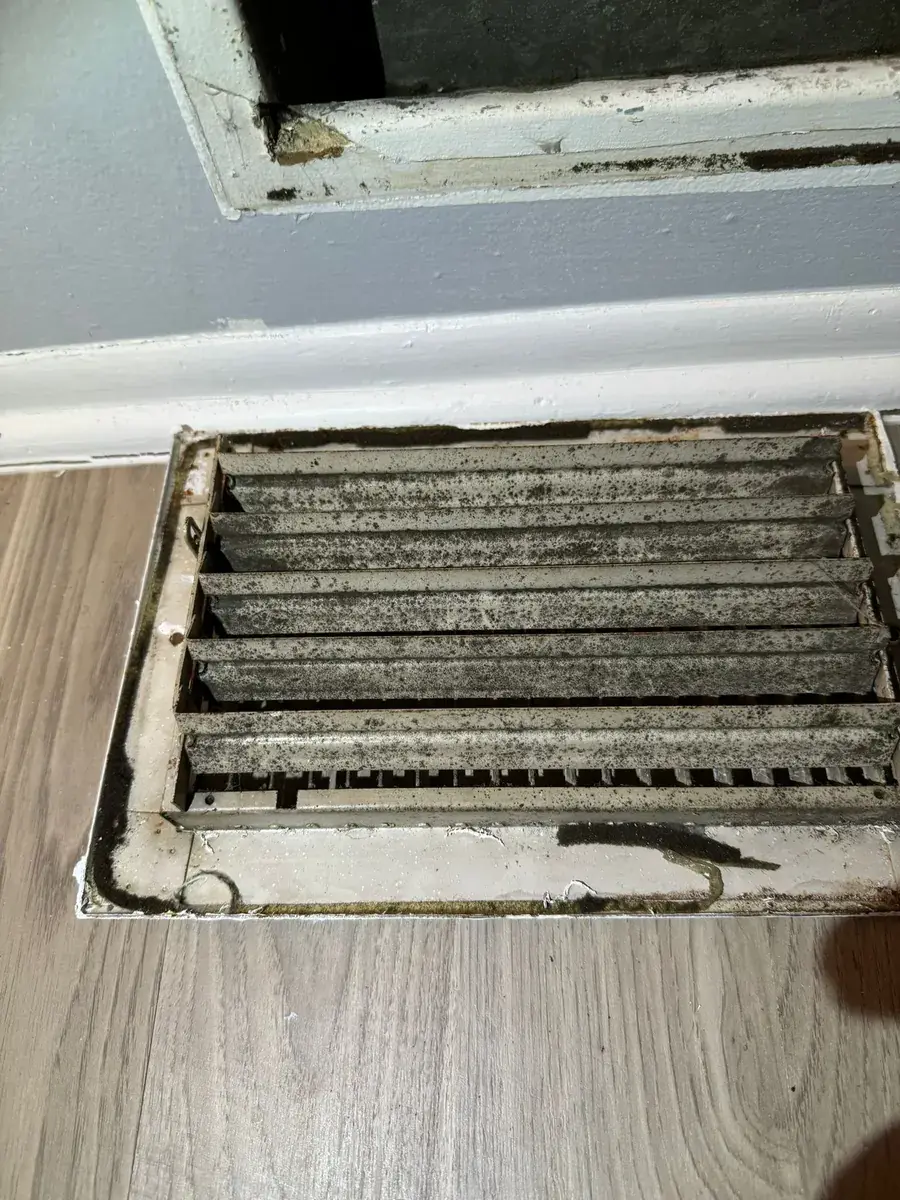
The return side tells the story
This floor return shows what settles where the system pulls air in — and in older homes the return side is consistently the dirtiest part of the system, especially with panned joist returns in the mix. To be clear about what cleaning does and does not do: the EPA does not endorse duct cleaning as a routine cure-all, and we will not pretend otherwise. But buildup at this level is one of the cases where cleaning is plainly warranted, and removing it can help reduce the dust your system recirculates. If you are weighing the decision, start with our guide to the signs your ducts need cleaning.
How do we clean older ductwork without damaging it?
Carefully, and with eyes inside the system the whole time. Every job starts with a free video inspection, so we know the materials, the routing, and the condition before a single tool goes in. Then we connect a professional Nikro negative-pressure machine to the trunk, put the system under vacuum, and work each supply and return with air whips and agitation tools matched to the material — aggressive enough to break fifty years of buildup off galvanized steel, dialed back for duct board and flex. Debris travels to a HEPA-filtered collection unit, not into your rooms, and you get after-photos of the same runs the camera showed you at the start. The step-by-step is on our process page.
Older homes are quoted the same way as everyone else: the free video inspection comes first, then a flat, written quote before any work begins — no "old house surcharge," no trip fees anywhere in our service area, and none of the $49-to-$99 coupon bait-and-switch that plagues this industry. The quote you approve is what appears on the invoice, with no door-step upsell, and Wisetack financing is available if you would rather spread the cost. You can read how our quoting works on our pricing page. E Cleaning is a PA licensed contractor (PA 187935), insured up to $2 million, and Google Guaranteed with money-back protection up to $2,000 on qualifying jobs.
One more old-house item: the dryer vent
Retrofitted laundry areas are the rule in older homes, and retrofitted dryer vents tend to be long, with extra elbows, sometimes routed through stone or brick walls wherever an opening could be made. Every elbow is a lint trap, and lint buildup is a genuine fire hazard, not just a drying-time nuisance. Pairing a dryer vent cleaning with duct cleaning while we are already on site is the easy move — we scope it into the same flat, written quote before any work begins, so there is nothing to renegotiate at the door. The full picture is on our dryer vent fire safety page.
The bottom line
Older Greater Philadelphia homes are not harder to love, but they are different to clean: retrofitted routing, mixed materials, mid-century quirks like panned returns, and accumulation that started before you were born. The right approach is inspection first, tooling matched to the ductwork, honest limits around asbestos-era materials, and photos that prove the work. That is how we handle it, from pre-war stone on the Main Line to split-levels in Bucks County.
We serve Montgomery, Chester, Bucks, Delaware, Berks, and Philadelphia counties from our King of Prussia base, around the clock, Sunday through Friday — we're closed Saturdays. Tell us the age of your house when you call — it helps us bring the right tools the first time.
