
How Long Does Air Duct Cleaning Take? (Real Timelines)
"How long will this take?" is usually the second question we hear after price, and it deserves a straight answer — because time is the most honest signal in this industry. Dislodging years of compacted dust from every duct run and pulling it into a sealed collection machine simply takes hours. Here is the real timeline stage by stage, what stretches it, how the dryer vent compares, and why a suspiciously fast crew is telling you something important about what they are not doing.
How long does professional air duct cleaning take per system?
Plan on two to three hours per HVAC system. "Per system" means one furnace or air handler plus every supply and return duct connected to it — not per house. A typical single-family home in our Montgomery, Chester, Bucks, and Delaware county service area — a rancher, split-level, or modest colonial with one furnace in the basement and 10 to 15 registers — lands squarely in that window. Larger colonials and newer builds often run two systems, one per floor or a separate zone for a finished attic or addition, and each system is its own full cleaning.
The range is honest because houses vary. A one-system home with rigid metal ductwork, an unfinished basement, and clear register access can be done closer to two hours. The same square footage with flex duct in a tight attic, furniture in front of half the returns, and a decade of buildup will push past three. When you book an air duct cleaning with us, the free video inspection at the start of the visit shows you and the crew exactly what is inside the runs before any cleaning begins — so if the job is going to run long, you know it in the first fifteen minutes, not the last.
What happens during those two to three hours?
A real source-removal cleaning is a sequence, and every stage exists for a reason. Skip any of them and you get a "cleaning" that leaves the dust roughly where it started. Here is how a typical single-system visit breaks down:
| Stage | What happens | Typical time |
|---|---|---|
| Setup and protection | Drop cloths and floor protection go down; equipment is staged in from the van | 15–20 min |
| Free video inspection | A camera goes inside the supply and return runs; you see the footage before work starts | 10–15 min |
| System hookup | The negative-pressure machine is connected to the main trunk and the registers are sealed | 15–25 min |
| Supply runs | Air whips and brushes agitate every supply branch individually while the vacuum extracts | 40–60 min |
| Return runs and trunk lines | Returns are cleaned, then the main trunks are worked toward the collection hose | 30–45 min |
| Registers, final pass, after-photos | Covers cleaned and reinstalled, work areas tidied, after-photos taken and reviewed with you | 15–25 min |
Add it up and you get roughly two hours on the fast end and a little over three when everything runs long — which is exactly where the 2–3 hour figure comes from. The two big blocks in the middle, the supply and return cleaning, are the job itself. Each branch run gets agitated from the register end toward the trunk while the entire system sits under negative pressure, so loosened debris travels in one direction only: into the sealed, HEPA-filtered machine.
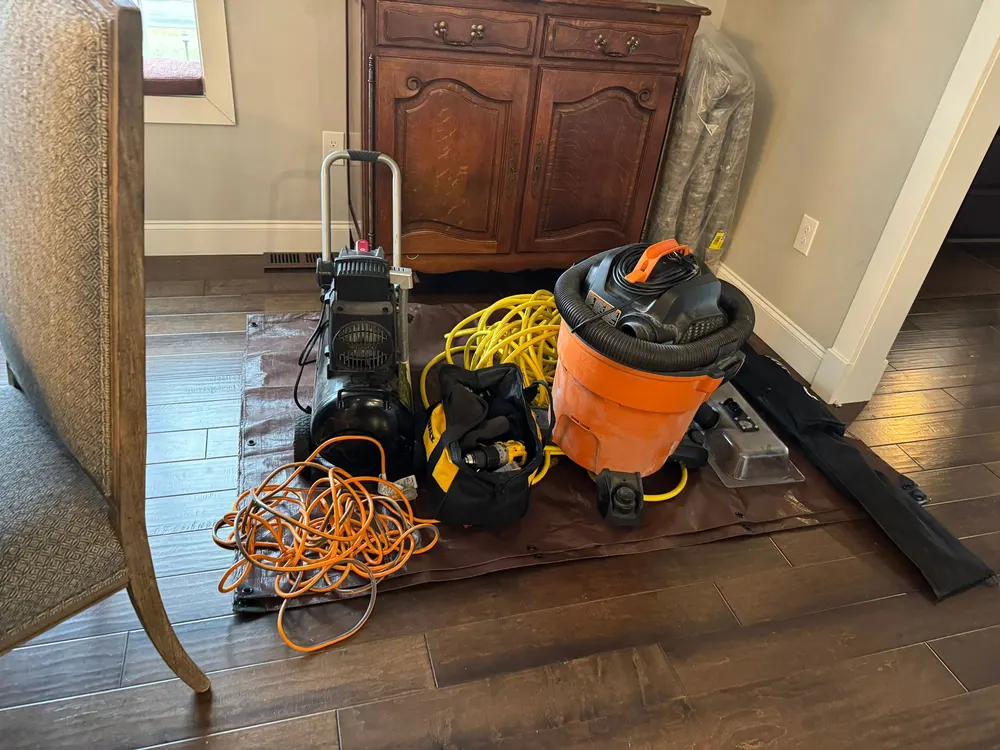
The equipment is a big part of why the timeline is what it is. Connecting a professional Nikro negative-air machine, sealing every register in the house, and feeding compressed-air agitation tools down each run is deliberate, physical work. You can see the full sequence on our process page, and our guide to source-removal duct cleaning explains what each tool is actually doing inside the ducts while the clock runs.
What makes a duct cleaning take longer?
Six factors account for nearly every job that runs past the three-hour mark:
- Additional HVAC systems. Each furnace or air handler is a separate full cleaning. A two-system colonial is a 4–6 hour visit. Your written quote covers every system before the work begins — but the time per system does not shrink.
- Vent count and home size. Every supply and return is cleaned individually, so a 20-register home has twice the runs of a 10-register home, and the middle stages of the job scale with it.
- Access. Attic air handlers, crawlspace ductwork, closets packed in front of returns, and finished ceilings around trunk lines all slow the hookup and agitation stages.
- Flex duct. The inner liner tears under aggressive brushing, so flex runs get gentler, slower agitation than rigid sheet metal.
- Heavy buildup. Systems that have never been opened, post-renovation drywall dust, and pest debris need extra passes before the camera shows clean metal.
- Add-ons. Sanitizing with EPA-registered products adds roughly 30–45 minutes after the cleaning, and a dryer vent added to the visit adds another 30–45.
None of these are padding — they are physics. More ductwork means more runs to agitate; harder access means slower hookups; heavier buildup means more passes per run. What should never change with any of them is what you pay: the free video inspection happens first, you get a flat, written quote before any work begins, and that quote is the number on the invoice whether the job takes two hours or four — no trip fees anywhere in our service area, no surprise line items, no door-step upsell.
How long does dryer vent cleaning take?
A standalone dryer vent cleaning takes 30 to 60 minutes. The short end is a basement or first-floor laundry hookup with a short, fairly straight run to an exterior wall. The long end is an upper-floor laundry with a long vent run full of elbows, or a line that terminates on the roof — the technician has to clean from both ends and physically reach the termination. A vent packed solid with compacted lint also takes longer than one with routine buildup, because the rotary brush has to work through the clog in stages while the vacuum extracts what it frees.
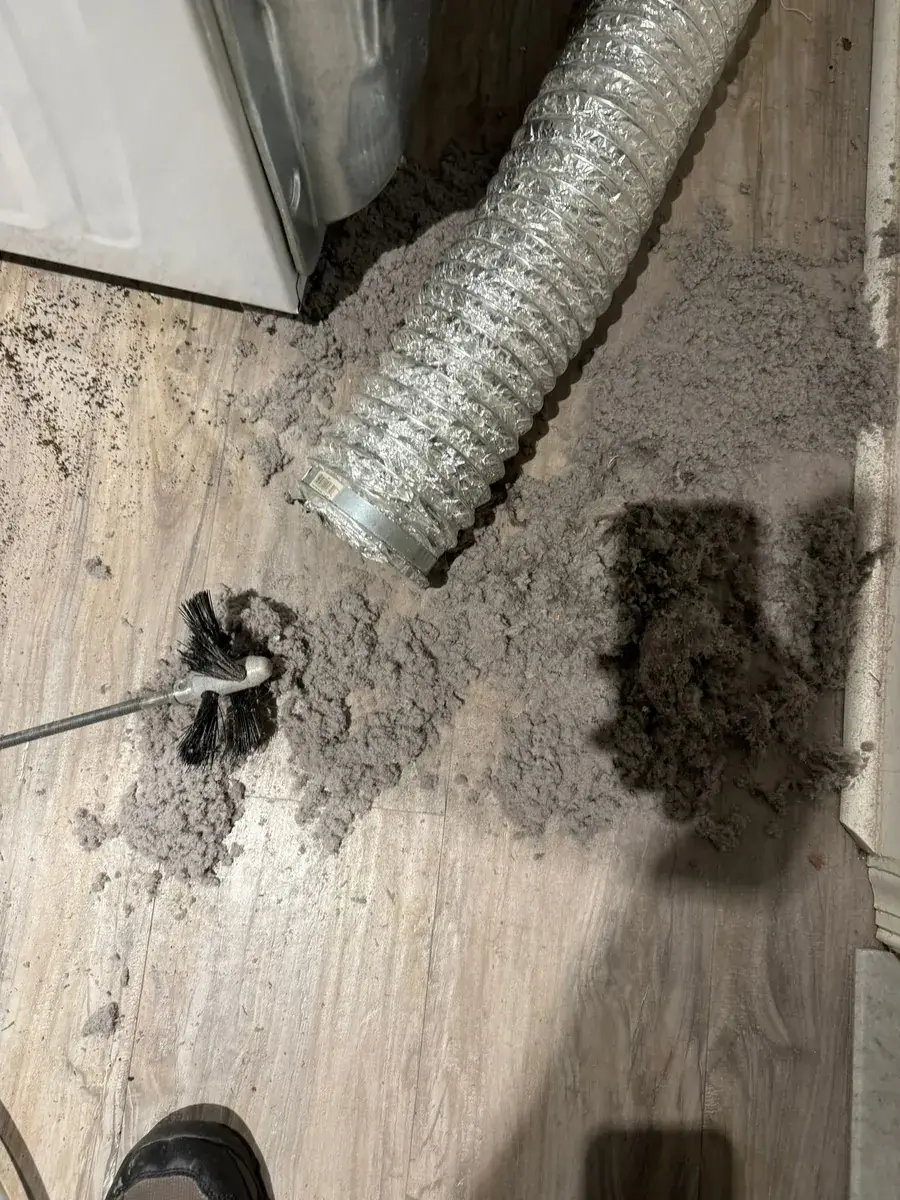
Half an hour to an hour is a small ask for the risk it retires. Lint is not a housekeeping nuisance — it is fuel sitting in a heated exhaust line.
Most customers add the dryer vent while the duct crew is already on site, which is the efficient move — the equipment is out, the visit grows by well under an hour, and both exhaust paths in the house get handled the same day. If your dryer is already taking two cycles to dry a load or the laundry room smells hot, do not wait for the next duct cleaning; our dryer vent fire safety guide walks through the warning signs that mean the vent needs attention now.
Why is a 20-minute duct cleaning a red flag?
Because the arithmetic does not work. A modest home has 10 to 15 supply and return openings. In a 20-minute visit, that is roughly 90 seconds per register — barely time to unscrew a cover, let alone seal the system, establish negative pressure, and run agitation tools down every branch to the trunk. A crew that is in and out in 20 to 45 minutes did one of two things: waved a shop-vac wand a few feet into each register, or spent the time writing up an upsell sheet. Either way, the compacted layer deep in the runs — the reason you called — never moved.
Fast cleanings and teaser prices travel together. The $49–$99 "whole house special" only makes business sense if the crew spends almost no time in your home, or turns the visit into a room-by-room upsell that lands somewhere north of what an honest flat rate would have cost. No company can run a multi-hour, equipment-heavy job for $49 and stay solvent. We broke down exactly how that pitch works in our guide to the $49 duct cleaning special — but the short version is: ask any company how long the job will take before you book. If the answer is under an hour for a whole house, you have learned everything you need to know.
How should you plan your day around the appointment?
Block out half a day to be safe — a one-system home is typically a 2–3 hour visit, and it is better to have the afternoon free than to be watching the clock. You do not need to hover, but plan to be home at the start, when the technician walks you through the video inspection footage and confirms the scope, and at the end, when you review the after-photos together. In between, most customers work from home or run errands while an adult stays on site.
A little preparation shaves real time off the visit: clear a path to the furnace or air handler, move furniture away from return grilles if you can, and keep pets in a closed room away from the work areas — the compressed-air tools are loud in short bursts, and doors will be opening as equipment moves in and out. Your heat or air conditioning will be off while its system is being cleaned, so on extreme-temperature days we simply time the work so the house never has long to drift. The system goes right back on the moment the job is done.
How long until you need it again?
Duct cleaning is not an annual chore. For most homes, the results of a proper source-removal cleaning last for years, with the right interval depending on pets, allergies, renovations, and how the home is used. There is a reason we take after-photos: the inside of the ducts should still look clean the next time anyone checks. For a full breakdown of intervals and the situations that reset the clock, see our guide on how often air ducts should be cleaned.
E Cleaning is family-owned and has served southeastern Pennsylvania from our King of Prussia base since 2016. We are PA licensed (PA 187935), insured up to $2 million, and Google Guaranteed with money-back protection up to $2,000 on qualifying jobs. Every job starts with a free video inspection, you get a flat, written quote before any work begins, financing is available through Wisetack, and every visit ends with after-photos — so the hours we spend in your home are hours you can verify.
