
Winter Is Dryer Fire Season: Prepare Your Laundry Room Now
Dryer fires follow the calendar. When the weather turns cold, households dry heavier fabrics, run more loads, and push longer cycles through a vent line that the cold itself is working to restrict — stiff flaps, frozen lint mats, snow-drifted terminations. This guide walks through exactly how winter stacks the odds against your dryer vent, what national fire data says about the season, and the pre-winter checklist that gets your laundry room ready before the cold — and the risk — arrives.
Why Is Winter Dryer Fire Season?
Because everything that causes dryer fires gets worse at the same time. A dryer fire needs three ingredients: fuel, heat, and restriction. Lint is the fuel. Long, hot cycles are the heat. A vent that cannot move exhaust outside fast enough is the restriction. Winter raises all three at once — heavier fabrics shed more lint, cold-weather loads run longer and hotter, and the exhaust path itself gets tighter as damper flaps stiffen, lint mats freeze, and snow piles up against the termination.
The national data reflects it. According to the U.S. Fire Administration, home clothes dryer fires are more frequent in the fall and winter months, peaking in January. That is not a quirk of the statistics — it is the predictable result of the heaviest laundry season of the year colliding with the worst venting conditions of the year. We break down all the numbers in our dryer fire statistics guide; the short version is that this is a common, seasonal, and largely preventable fire.
Read those two facts together and the takeaway writes itself. The leading factor in dryer fires is a skipped cleaning, and the fires cluster in the months when your vent works hardest. The window to act is before the season — which is exactly what the rest of this article is for.
How Is Cold-Weather Laundry Different From Summer Laundry?
It produces dramatically more lint per load. Summer laundry is t-shirts, shorts, and thin synthetics that shed little. Winter laundry is fleece, flannel sheets, sweatshirts, sweaters, blankets, and comforters — thick, fibrous fabrics that shed heavily every time they tumble. The lint screen catches only a portion of what comes off; the rest rides the exhaust air into the transition hose and the vent run, where it settles at every elbow and low spot.
Those same fabrics also hold far more water than summer clothing, so the dryer runs longer and hotter to dry them. More runtime means more lint pushed into the duct and more sustained heat inside it. A single winter month can deposit more lint in a vent line than an entire summer — on top of whatever was already there. If your vent goes into December carrying a year of buildup, the heaviest season of the year is working against a pipe that is already part-blocked.

What a heavy season leaves behind
This is the kind of lint volume we routinely pull from a single residential vent line. None of it was visible from the laundry room, and every load pushed heat past it. Winter fabrics build piles like this faster than any other season of the year.
A fall professional vent cleaning removes the whole backlog — transition hose, full run, and exterior hood — so the heavy season starts with a clear pipe.
What Do Holiday Loads Do to Your Dryer Vent?
They compress a month of laundry into a few weekends. Between Thanksgiving and New Year's, most households wash guest bedding before and after visits, extra towels for a full house, tablecloths, kids' clothes from winter break, and the everyday layers on top. The result is back-to-back-to-back dryer cycles — and back-to-back cycles never let the duct cool down. Heat builds in a line that is simultaneously collecting lint at the fastest rate of the year.
The holidays also change how people run the machine. Loads get started before bed so the guest sheets are ready, or before everyone leaves for a family dinner. Running a dryer while the household is asleep or out is the single habit fire officials warn about most, because the first minutes of a dryer fire are when someone present can contain it. During the holiday stretch: space loads out where you can, clean the screen between every load, and keep the dryer's runtime inside your waking, at-home hours.
What Happens to the Exterior Vent When Temperatures Drop?
The end of your vent line lives outside in the weather, and winter attacks it three ways. First, the damper flap — the hinged door that opens when the dryer runs — stiffens in the cold and can seize partially closed, restricting every load. Second, dryer exhaust is warm and moist; when it hits freezing outdoor air at a lint-matted termination, that moisture condenses and can freeze, hardening the lint into a crust that holds the flap down or narrows the opening. Third, snow drifts against low wall terminations and can bury them entirely, blocking the vent outright while the dryer keeps pushing hot, wet air against the obstruction.
Fall adds one more problem: warmth-seeking animals. An uncapped or damaged termination is an inviting winter shelter for birds and small animals, and nesting material sits in the airstream exactly where lint already accumulates.
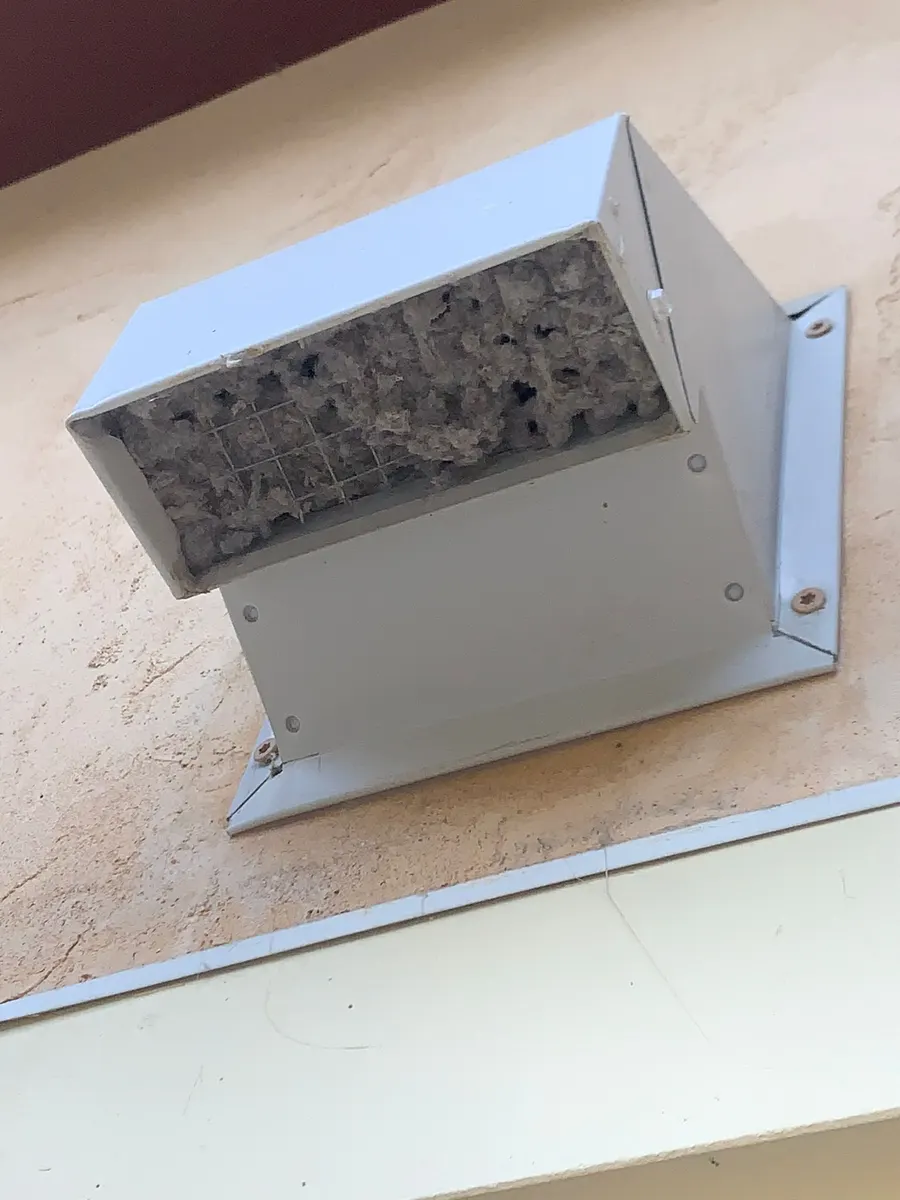
The five-minute walk-around
Start a load, then walk outside and find your vent termination. You should feel strong, warm airflow and see the flap standing fully open. Weak airflow, a flap that barely moves, or a lint beard like the one in this photo means the line is restricted before winter has even started.
Repeat the check after every hard freeze and every snowstorm. It costs nothing, and it catches the exact conditions that make the cold months the peak season for dryer fires.
How Does Each Winter Factor Stack the Odds?
Here is the season's arithmetic in one table — what changes when it gets cold, what that change does to your vent, and the move that answers it.
| Winter factor | What it does to your vent | Your move |
|---|---|---|
| Heavy fabrics (fleece, flannel, blankets) | Shed far more lint per load | Clean the lint screen every single load |
| Holiday guests and extra loads | More runtime, more lint, less cool-down | Space loads out; no marathon sessions |
| Longer, hotter cycles | Sustained heat inside a filling duct | Treat two-cycle drying as a warning, not a habit |
| Cold, stiff, or frozen damper flap | Restricts exhaust even in a clean duct | Verify the flap opens fully while the dryer runs |
| Snow at the termination | Can block the vent completely | Clear a path after every storm |
| A year of existing buildup | Every factor above hits a narrowed pipe | Book a professional cleaning in the fall |
Notice that five of the six answers are free. The one that is not — the professional cleaning — starts free too: a video inspection inside the line, followed by a flat, written quote before any work begins. It is the one move that resets the whole system to full capacity.
What Should Be on Your Pre-Winter Laundry Room Checklist?
Run this list once in the fall and your laundry room enters the heavy season in the best shape it can be in:
- Book a professional vent cleaning — the full line from the dryer connection to the exterior termination, not just the reachable first few feet.
- Pull the dryer away from the wall and vacuum behind and beneath it; confirm the transition hose is not crushed or kinked.
- Replace plastic or foil transition duct with metal. Semi-rigid or rigid metal resists ignition, crushing, and sagging.
- Verify the exterior flap opens fully while the dryer runs and closes completely when it stops.
- Keep the termination clear all season — check for snow, leaves, and matted lint after every storm and cold snap.
- Test the smoke alarm nearest the laundry area and replace its battery if it is due.
- Clean the lint screen every load, without exception — winter fabrics fill it faster than you are used to.
- Keep dryer runtime inside waking, at-home hours — never while asleep, never while out of the house.
- Watch your dry times. A load that suddenly needs a second cycle is the earliest reliable sign of a restricted vent — here is why clothes take two cycles to dry.
Want to know how your current setup scores before you start? The two-minute risk quiz on our dryer vent fire safety page walks through the same factors our technicians check on real jobs.
When Should You Schedule the Cleaning?
Fall — September through November — is the smart window. A fall cleaning means the vent enters the heavy season at full capacity, the exterior flap gets serviced before the first freeze can seize it, and any surprises inside the line — a crushed hose, a disconnected joint, summer nesting — get found while the weather still makes repairs easy. Waiting until January means running the biggest loads of the year through the year's worst buildup first.
Every E Cleaning dryer vent visit starts with a free video inspection inside the line, so you see the actual buildup before any work begins. We clean the transition hose, brush the full run under HEPA-filtered vacuum, service the exterior hood, then verify airflow and hand you after-photos. The whole visit usually takes under an hour, and you can read exactly how it works on our process page. We are a PA licensed contractor (PA 187935), insured up to $2 million, and Google Guaranteed with money-back protection up to $2,000 on qualifying jobs.
What Does Winter Prep Cost?
You will know the exact number before we touch a tool. Every job starts with a free video inspection inside the line, and you receive a flat, written quote before any work begins — no per-foot charges, no trip fees anywhere in our service area, no surprise invoice, and no door-step upsell. Compare that to the other side of the ledger: even a small, contained dryer fire typically means replacing the dryer, smoke remediation through the house, and an insurance deductible — each of which alone costs more than a decade of annual cleanings.
Many households pair the vent cleaning with air duct cleaning in the same visit — one appointment, one written quote, that puts both the heating season and the laundry season on a clean footing before the holidays, with financing available through Wisetack. We serve Montgomery, Chester, Bucks, Delaware, Berks, and Philadelphia counties from our King of Prussia base, around the clock, Sunday through Friday — we're closed Saturdays.
