
Dryer Vent Cleaning in Tinicum, PA
E Cleaning clears dryer vents across Tinicum Township end to end — from the transition hose behind the machine to the hood, foundation, or roof cap where the run terminates. Every job starts with a free video inspection, you get a flat written quote before any work begins, and there is no trip fee for the drive out to the river townships.
Where the dryer lives decides what the vent run looks like
In Tinicum Township, the dryer vent problem is really a housing-era problem. This is a rural township of detached homes — stone farmhouses, River Road cottages near Erwinna and Uhlerstown, mid-century houses along the Route 611 side near Ottsville, and newer custom builds on wooded acreage — and each era put the laundry somewhere different, which means each era created a different vent run.
Geography sets the terms here. Tinicum sits in the northeast corner of upper Bucks County, strung along the Delaware River, with River Road — PA Route 32 — tracing the water past Erwinna and Uhlerstown while Route 611 carries the western edge toward Ottsville. The Delaware Canal and its towpath run the length of the township between the road and the river, and Uhlerstown is tied to Frenchtown, New Jersey by a narrow one-lane bridge across the Delaware. It is preserved, wooded, agricultural country — houses sit far apart on acreage and up long drives rather than packed into blocks — and that low density, paired with a damp river corridor, shapes both how the homes were built and how their dryer vents behave.
In the old stone farmhouses, laundry almost always lives in the basement. The vent has to escape through a rim joist, and in a house with thick masonry walls that can mean a long horizontal run across the basement ceiling just to reach a side of the house where daylight is possible. These are fieldstone-and-plaster houses with no interior chases to hide ductwork, so the vent gets strung out in the open across the basement ceiling, sagging between joists at every point where lint then pools. Long and flat is the worst shape for a lint duct: airflow slows, moisture lingers, and lint settles along the whole bottom of the run instead of blowing clear.
The riverbank cottages tell a different story. Laundry was squeezed in during winterization or a later remodel — a closet, a back porch, a corner of the kitchen — and the vent went wherever it could: down through a crawlspace, out through the foundation, or up through the roof because no exterior wall was close enough. Improvised runs like these pick up elbows, and every elbow is a lint trap.
The newer custom homes flip the problem upstairs. Second-floor laundry rooms are standard in houses built here from the 1990s on, and they produce the longest concealed runs we see: duct dropping through framing or climbing to a roof cap, invisible for its entire length, in a house big enough that nobody has thought about it since the drywall went up. And in every era of house, dryers migrate — basement to mudroom to hall closet over successive renovations — while the vent path quietly grows longer behind the walls.
One thing Tinicum does not have is attached-housing density. There are no townhome rows here sharing party walls; the exposure is the opposite kind. Homes sit far apart, up long gravel drives, and rural upper Bucks is protected by volunteer fire companies covering large territories from a handful of stations. That is exactly the setting where prevention has to do the work — a laundry fire at the end of a half-mile driveway is a bad place to test response times.
What a clogged vent actually risks — and how Tinicum makes it worse
Lint is fuel. A blocked vent traps the heat that ignites it. That is the whole mechanism, and the national numbers behind it are not small.
Tinicum adds its own aggravating factors. The creek valleys and the river corridor run humid for much of the year, and damp lint clumps and clings inside the duct instead of blowing free — a run that would stay marginal in a dry climate packs solid here. Exterior terminations in a wooded township are wildlife real estate: birds and mice move into vent hoods every spring, and an idle hood on a weekend house is even more inviting than a busy one. The common homeowner fix — a mesh screen over the hood — backfires, because screens catch lint and build a total blockage faster than most nests do; a proper bird guard is the right hardware, and we will tell you honestly whether yours qualifies.
Usage patterns matter too. Some Tinicum houses are weekend and seasonal homes, which means the dryer sits idle for days and then runs back-to-back loads of linens and towels — the heaviest, dampest loads a dryer handles — through a vent nobody has inspected in years. Year-round households have their own surge season: winter, when outdoor lines are finished and the dryer carries everything. Watch for the signs that the run is falling behind:
- Towels and heavy loads needing a second cycle
- Clothes and the dryer top noticeably hot at the end of a run
- A humid, lint-smelling laundry area while the machine runs
- Little or no airflow at the exterior flap — or a flap that never opens
- Lint accumulating at the connection behind the dryer
- The dryer tripping off mid-cycle on thermal overload
Any one of these earns an inspection, and ours is free — with a camera, so you see the condition of the run yourself instead of taking a stranger's word for it.
Fire is the headline risk, but a restricted vent costs you steadily long before anything dramatic happens. Every second cycle doubles the energy that load consumes, and a dryer straining against a half-blocked duct runs hotter and wears out its heating element, thermostat, and drum bearings years ahead of schedule. On a rural property where replacing an appliance means a real trip, keeping the machine you already own healthy counts for something too — and a clear vent is the cheapest maintenance a dryer ever gets.
What the free video inspection shows — and how we clean the run
Every Tinicum dryer vent job opens the same way: a camera goes down the duct before anyone quotes a number. On a rural run you cannot see from the laundry room, that footage is the entire point — you watch the condition of your own vent instead of trusting a stranger's description. Here is what the inspection reads:
- Total length and routing of the run, and how many elbows it turns through
- Termination type — wall hood, foundation exit, or roof cap — and whether the flap still opens
- The material and condition of the transition hose behind the dryer
- How deep the lint is packed, and where along the run it concentrates
- Nesting material or wildlife intrusion at the exterior hood or cap
- Disconnected or sagging joints leaking lint into a wall or floor cavity
- Moisture staining that signals a run already venting too slowly
The cleaning itself uses the source-removal approach — the same principle NADCA sets as the industry standard, though we do not claim its membership or certification. Rather than blow lint loose and hope it finds the exit, we put the run under negative pressure with a professional Nikro machine, drive rotating brushes and compressed-air agitation through every foot to break the lint off the duct wall, and capture all of it through HEPA filtration into sealed equipment. Nothing gets pushed into your laundry room, your basement, or a wall cavity.
What the camera shows also decides the honest scope. A routine maintenance cleaning — a run cleared within the last year or two, carrying normal lint — is a genuinely different job from a deep restoration of a vent that has never been cleaned, is packed solid, or is bird-nested at the cap. We scope those as the two different services they are, and put the price in writing before any tool comes out, so the inspection determines the work rather than a doorstep decision made for you.
What we clean, by the kind of run your house has
A professional cleaning covers the entire run, not the few reachable feet behind the machine — and in Tinicum the runs vary enough that no two jobs are shaped quite alike. Here is how the common configurations get handled:
| Run type | Where we find it | What the job involves |
|---|---|---|
| Basement run to rim joist | Stone farmhouses, older village homes | Rotary brush agitation down the full horizontal length with HEPA-filtered extraction; joints and sags checked on camera |
| Crawlspace or foundation exit | Winterized river cottages | Both ends cleaned, elbows cleared individually, termination hardware checked and freed |
| Second-floor concealed run | Newer custom homes on acreage | Full-length cleaning through framing, airflow verified at the termination since the duct itself is invisible |
| Roof termination | Cottages and upstairs laundries alike | Cleaned from both ends including the roof cap, where lint mats and nests concentrate |
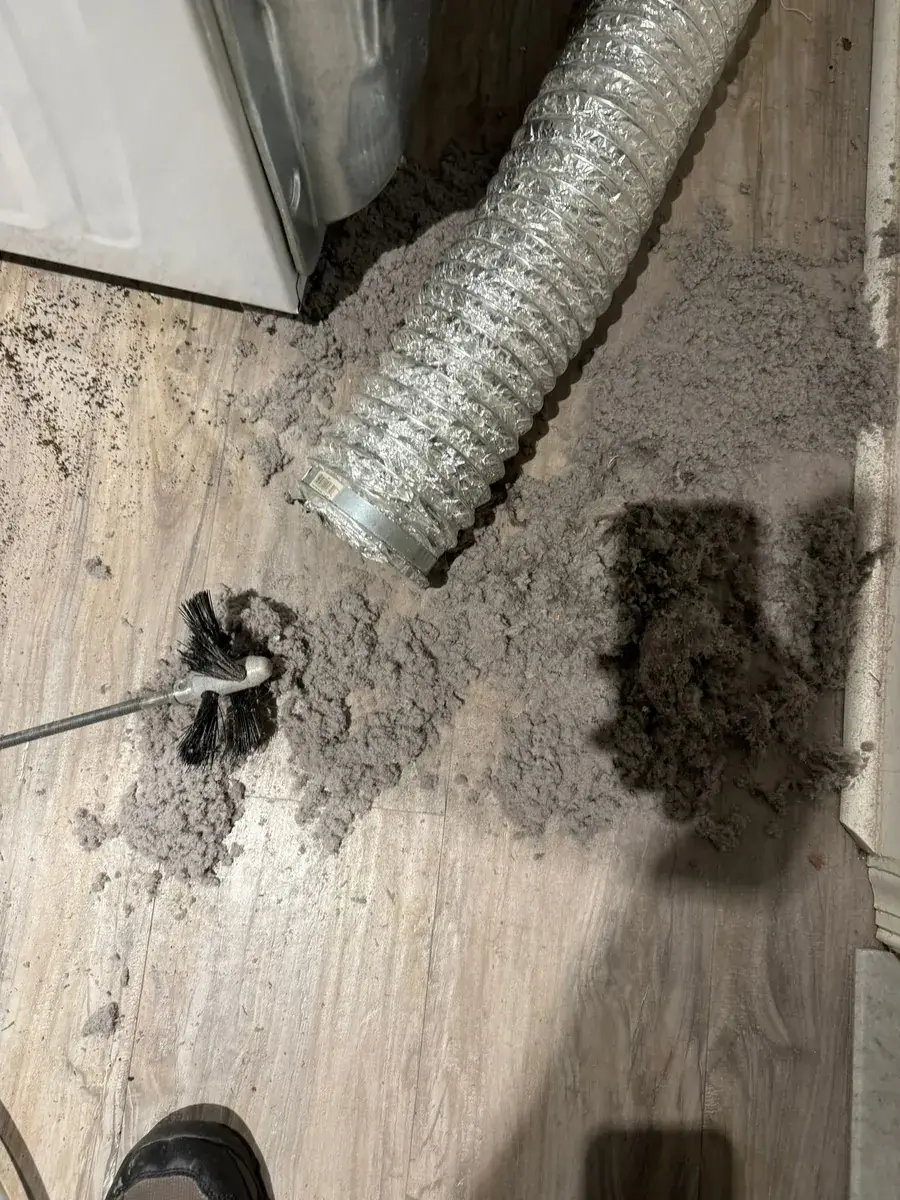
Whatever the configuration, the physical work follows the run end to end. We start at the transition hose behind the dryer and clean through to the exterior — driving brush agitation the full length of a farmhouse basement run, clearing each elbow of an improvised cottage route on its own, and working a concealed second-floor run through its framing all the way to the roof cap. Nesting material comes out of the hood or cap, the exterior flap is freed so it opens and seals on its own again, and every bit of lint we break loose is drawn back into HEPA-filtered equipment rather than left in the duct. If the transition hose is plastic or foil flex, we show you on camera why it should be swapped for semi-rigid metal — those hoses sag, trap lint in their ridges, and are the first component to ignite. We finish by verifying airflow at the termination and photographing the cleaned run, so even a vent hidden inside the walls comes with proof it is clear from end to end.
One visit can cover both systems
Most Tinicum customers pair the dryer vent with air duct cleaning in Tinicum — one crew makes the drive out River Road, both systems go on camera, and one written quote covers everything. In a township where every service visit involves real mileage, bundling the inspection makes plain sense, and the inspection is free either way.
Accountable to the written quote, wherever the driveway ends
E Cleaning has been family-owned since 2016, working out of King of Prussia as PA licensed contractor 187935, insured up to $2 million, Google Guaranteed with money-back protection up to $2,000 on qualifying jobs, and rated 4.8 stars across 144 Google reviews. Our license and insurance documents are viewable at our licensed & insured page. Every job carries a 6-month workmanship warranty, and a Price Match Guarantee against any competitor's written quote for the same scope of work. Financing is available through Wisetack. We work around the clock, Sunday through Friday, with a 24-hour emergency line for the after-hours situations — like a dryer that overheated mid-cycle and a household wondering whether the vent is why.
The terms do not change with the zip code: no trip fees, no mileage line items, no rural surcharge — not in Tinicum and not in the neighboring townships. We cover the same roads for dryer vent cleaning in Bridgeton, Nockamixon, and Plumstead, and the full list is on our Bucks County service hub.
How much does dryer vent cleaning cost?
Routine and deep cleaning are different services — the free inspection determines which one your system actually needs. Prices vary house to house; your exact price comes as a flat written quote before any work begins.
| Dryer vent routine — basement / 1st floor | $129.99 |
| Dryer vent routine — 2nd floor & up | $149.99 |
| Dryer vent deep cleaning | $299.99 |
| Nest removal · bird guard installation | from $250 · from $150 |
Three promises. In writing. On every job.
Price Match Guarantee
Bring a competitor's written quote for the same scope of work — we'll match it. You never overpay for doing it right.
6-Month Warranty
Every job carries a 6-month workmanship warranty. If a problem traced to our work shows up, we come back and make it right — free.
Google Guaranteed
Booked through Google Local Services, qualifying jobs carry Google's own money-back protection up to $2,000, administered by Google.
Backed by a real license and $1M/$2M insurance — see the actual documents
Don't put off air you breathe — finance it with Wisetack
Check your options in about a minute with no impact to your credit score, choose terms that fit your budget, and pay over time instead of all at once.
*All financing is subject to credit approval. Your terms may vary. Wisetack loans are issued by Hatch Bank. See additional terms at wisetack.com/faqs.
4.8 stars from 144 Google reviews — and easy to find
E Cleaning Duct & Vent Cleaning is based at 555 S Goddard Blvd, King of Prussia, and serves Tinicum and all of Bucks County from right here. Check our Google profile: real jobs, real photos, and a rating our crew protects on every visit.
- Google Guaranteed business — screened, licensed and insured (see the documents)
- Read every review on our Google profile — we don't cherry-pick what you can verify
Dryer Vent Cleaning questions from Tinicum homeowners
Do you charge extra to come out to Erwinna, Uhlerstown, or the Ottsville side of Tinicum?
No. There are no trip or travel fees anywhere in our service area, and the river townships are no exception. The video inspection is free, and the flat written quote you approve before work begins is the entire price, regardless of how far up River Road the house sits.
Our laundry room is on the second floor. Why does that change the job?
Because the vent run is long, concealed, and usually vertical or roof-terminated — the hardest configuration to keep clear and the easiest to forget, since you never see any of it. Lint has more distance to travel and more framing to hide in. We clean the full length, verify airflow at the termination, and photograph the result, so a run you cannot see is still a run you can confirm is open.
The house is a weekend place and the dryer only runs a few days a month. Do we still need this?
Idle vents have their own failure mode: birds and mice treat an unused hood as an empty nest box, and upper Bucks gives them plenty of opportunity. Then the first weekend back, the dryer pushes back-to-back loads of damp linens through a blocked run. A free inspection tells you where the vent actually stands, and if it is clean we say so and leave — condition decides the scope, not the calendar.
Our vent exits through the roof. Can you handle that?
Yes. Roof terminations are common in the river cottages and in newer homes with upstairs laundries, and we clean them from both ends — the full duct plus the roof cap itself, which is where lint mats and nesting material concentrate. The inspection confirms the routing before anything goes in the written quote.
Is a screen over the outside vent hood a good idea out here?
No, and this surprises people, because wildlife in the hood is a real problem in a wooded township. Mesh screens catch lint and build a full blockage faster than most nests do, which trades one fire risk for a worse one. A purpose-made bird guard keeps animals out while letting lint pass. We check the termination hardware on every inspection and will tell you plainly which one you have.
How long does a dryer vent cleaning in Tinicum take?
A routine cleaning is usually about an hour once the inspection and written quote are settled. Long farmhouse basement runs, roof terminations, and deep restorations of packed or nested vents take longer — and because the quote is flat and written before work begins, you will know the scope, and that the number will not move, up front.
Ready for honest dryer vent cleaning in Tinicum?
Free video inspection, a flat written quote before any work, and real before/after proof — call (484) 367-5944 or book online now.
