
Dryer Vent Cleaning in Upper Salford, PA
E Cleaning provides professional dryer vent cleaning throughout Upper Salford Township — from farmhouse basement laundries outside Salfordville to second-floor laundry rooms in newer homes near Woxall. A free inspection comes first, then a flat written quote before any work begins, backed by a licensed (PA 187935), insured, highly rated local company.
Where Upper Salford Does Its Laundry — and Why It Changes the Job
Upper Salford Township sits in the northwestern corner of Montgomery County, in the heart of the Perkiomen Valley where the county's suburban grid gives way to farmland, woods, and creek bottoms. It is a small, low-density township — the villages of Salfordville and Woxall anchor it — bordered by Lower Salford toward Harleysville, Salford Township to the west, and Marlborough Township and the Green Lane Reservoir area to the north. Rural two-lane roads such as Gravel Pike (Route 29) and Sumneytown Pike thread the township and connect it to the larger towns where residents shop and commute. That spread-out character shapes the housing here — and the housing, in turn, shapes the dryer vents.
Nearly everything in Upper Salford is detached single-family housing on generous lots. Unlike the denser boroughs and townhome developments downstream along the Perkiomen — where a dryer often vents a few feet straight through the wall of a compact utility closet — this quiet township of a few thousand residents has almost no attached housing. That is good news for privacy and mixed news for dryer vents: detached rural homes tend to have longer, more varied vent runs, and the laundry can be almost anywhere in the house.
Three setups cover most of the township. In the older farmhouses and mid-century ranches along the back roads between Salfordville and Woxall, the dryer usually lives in the basement, venting up through the rim joist or pushing a long horizontal run across the ceiling to reach an exterior wall — and every foot of that run, and every elbow in it, is a place where lint slows down and stays. In homes built or remodeled from the 1980s onward, laundry often moved up to a first-floor mudroom; the run to the outside gets shorter, but the crimped flexible transition hose crushed behind the machine frequently becomes the choke point instead. And in the township's larger colonials from the 1990s and 2000s, second-floor laundry rooms are common — which means concealed runs through wall cavities and, in some layouts, straight up through the roof.
One more local detail: with little natural gas service in the township, dryers here run on electricity or propane. A propane dryer sends combustion byproducts and moisture out through the same duct as the lint, so a restricted vent isn't just a drying-time problem — it pushes humid exhaust back toward the laundry area and makes the burner work against its own backpressure. Electric units suffer differently, cycling their thermal limiters as heat builds, which is why an aging dryer often gets blamed for what is actually a clogged vent.
There is a rural wrinkle worth naming. Many of the township's older farmhouses were built long before an electric or propane dryer was ever a consideration, so the vent was added decades later and routed wherever it was easiest — up and over floor joists, along a basement ceiling, out through a stone or block foundation wall. Those retrofitted runs are often longer and more crooked than anything a modern builder would install, and every added elbow is one more place lint packs in and stays. It is less a defect than what happens when a century-old house meets a modern appliance — but it does mean the vent deserves a closer look than a short, straight builder run.
The floor your laundry sits on effectively decides the shape of the work. A basement dryer fighting twenty-five feet of duct and four elbows and an upstairs unit exhausting through a roof cap are entirely different cleaning jobs. We scope them honestly: a free inspection first, then a flat written quote before any work — and no trip fee anywhere in Upper Salford Township, whether your mail says Schwenksville, Harleysville, or Green Lane.
Fire Safety When the Fire Company Is a Long Drive Away
A clogged dryer vent is one of the most preventable fire hazards in any home, and prevention counts double in a rural township. Like most of this corner of northwestern Montgomery County, Upper Salford is protected by volunteer fire companies covering wide, spread-out road networks — help is simply farther away here than it is in a borough, which makes not needing it the real strategy.
Winter is when the risk concentrates. Upper Salford's heating season is long, and it is also peak laundry season — towels, blankets, snow gear, and heavy work clothes shed far more lint than summer loads, so lint production spikes in exactly the months the dryer works hardest. Cold weather adds its own problems: exterior flaps stick or freeze partly shut, and long runs passing through unheated attics or crawlspaces cool the exhaust air, condensing moisture that turns loose lint into a damp, matted blockage that no lint trap ever catches.
Warning Signs Upper Salford Homeowners Shouldn't Ignore
- Loads need a second cycle to dry — the clearest early symptom
- The dryer top or the laundry room gets noticeably hot mid-cycle
- A burning or hot-lint smell while the dryer runs
- The exterior flap barely opens, or lint collects on siding or roof shingles around the cap
- No steady exhaust plume visible outside on a cold day
- Clothes come out smelling musty, or moisture builds in the laundry area
- It has been more than a year since the vent was professionally cleaned
What a Professional Dryer Vent Cleaning Includes
We clean the entire exhaust path, not just the part you can reach with the dryer pulled out. The visit starts with a free inspection of the full run — from the transition hose behind the machine, through every concealed foot of duct, to the termination outside — so the written quote describes the job your house actually needs.
Because so much of a dryer run is hidden inside walls, ceilings, and foundation, the inspection is not guesswork. Where the layout calls for it, we push a camera into the line and watch the screen with you: the video shows where lint has narrowed the duct and by how much, whether the transition hose behind the machine is kinked or crushed, whether a joint has pulled apart inside a wall cavity — a common hidden fault that leaks hot, moist, lint-laden air into the structure — and whether a bird or rodent has nested at the cap. That is how a run that seems fine from both ends gets diagnosed honestly, and how the written quote ends up matching the real job instead of a guess.
The cleaning itself works the duct from both ends. Rotary brushes sized to your duct diameter scrub the full length of the run while HEPA-filtered vacuum extraction captures what the brushes free, so lint ends up in our equipment rather than redistributed through the line or blown across your yard. The exterior termination — wall cap, rim-joist hood, or roof cap — gets cleared and its flap checked for free movement, because a damper that cannot open fully chokes even a freshly cleaned duct. Behind the machine, we inspect the transition hose: the flimsy foil and plastic types that come free with a dryer trap lint aggressively and crush flat when the machine is pushed back, and where one needs replacing with semi-rigid metal we say so in the written quote — never as a doorstep surprise.
Wooded rural settings add one hazard that surprises homeowners: wildlife. Birds and small rodents treat a warm, sheltered vent cap as prime real estate, and a nest packed into the termination blocks airflow as thoroughly as years of lint. We clear nesting material as part of the job, and where a cap keeps inviting tenants we can recommend a properly guarded replacement — one that keeps animals out without screening so fine that it clogs with lint itself, a common and genuinely dangerous mistake with hardware-store covers.
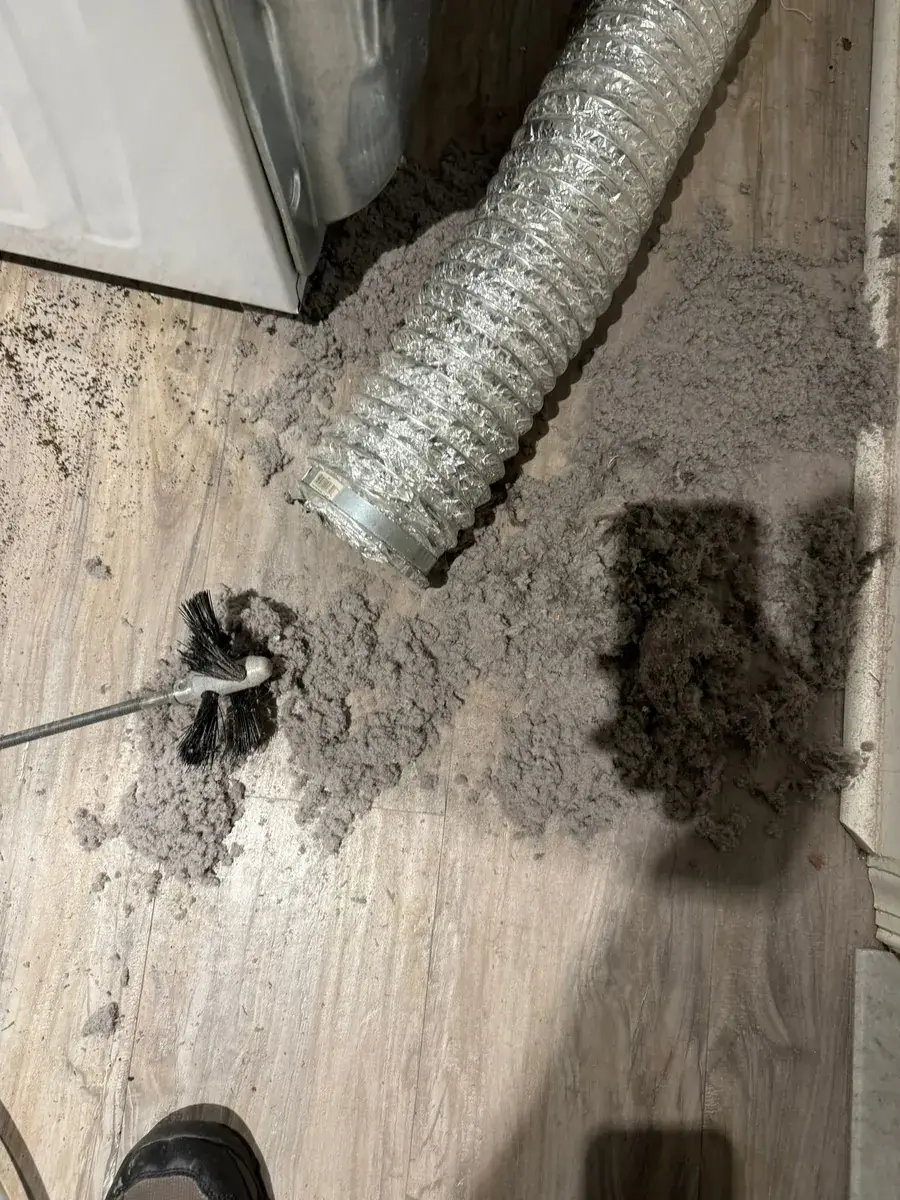
Before we leave, we verify airflow at the termination so you can feel the difference, and we document the result with after-photos. Most straightforward visits take about an hour; roof terminations and long concealed runs take longer — which is exactly why we quote after inspecting, in writing, and why the number holds.
Straight Answers on Scope and Schedule
Our cost structure is deliberately boring. The inspection is free. The quote is flat, written, and delivered before any work begins. Routine annual maintenance on a healthy vent and a first-time deep cleaning on a run that has never been serviced are honestly scoped as different jobs, because they are. And there is no travel charge to reach any address in Upper Salford Township.
What separates a routine cleaning from a deep one comes down to what the inspection finds, not a sales script. Routine cleaning is maintenance on a vent that has been kept up — a manageable layer of lint, an intact metal duct, a working exterior flap — and brushes plus extraction restore full airflow in about an hour. Deep cleaning is for the vent that has gone years without service or was never touched: lint compacted the length of the run, a matted moisture-and-lint blockage near the exterior, a nest to clear, or a crushed transition hose to replace. That work takes longer and the quote reflects the added labor — but you will know which one your vent needs, and why, before you approve a thing.
Those promises have teeth: bring a competitor's written quote for the same scope and we match it; every job carries a 6-month workmanship warranty — plus Google Guaranteed money-back protection up to $2,000 on qualifying jobs. We are a licensed Pennsylvania contractor (PA 187935), insured to $2 million and rated 4.8 stars across 144 Google reviews, with the documents posted for anyone to view. Financing is available through Wisetack.
How often should this happen? Once a year for most households, in line with fire-safety guidance — more often for big families running daily loads, homes with shedding pets, or the long multi-elbow runs common in the township's larger homes. Very long runs sometimes raise the question of a booster fan; our honest position is that most vents that seem to need one actually need a proper cleaning first, and the inspection settles which situation yours is before anyone spends money on hardware.
The payoff shows up beyond safety, too. A clear vent means shorter dry times, which means fewer hours of runtime per week, less heat-cycling wear on the machine's heating element and motor, and less electricity or propane burned per load — the dryer is among the hungriest appliances in the house, and it is at its hungriest when it is fighting a blocked exhaust. We work around the clock, Sunday through Friday, and answer around the clock for emergencies.
Dryer Vent Service Across the Perkiomen Valley
The same trucks that cover Upper Salford handle dryer vent cleaning in Lower Salford on the Harleysville side, Spring Mount just across the creek, and Perkiomenville up Gravel Pike. The full coverage map is on our Montgomery County page.
Many homeowners pair a vent cleaning with our air duct cleaning in Upper Salford — the technician and the equipment are already in your driveway, and both services start with the same free inspection and flat written quote.
How much does dryer vent cleaning cost?
Routine and deep cleaning are different services — the free inspection determines which one your system actually needs. Prices vary house to house; your exact price comes as a flat written quote before any work begins.
| Dryer vent routine — basement / 1st floor | $129.99 |
| Dryer vent routine — 2nd floor & up | $149.99 |
| Dryer vent deep cleaning | $299.99 |
| Nest removal · bird guard installation | from $250 · from $150 |
Three promises. In writing. On every job.
Price Match Guarantee
Bring a competitor's written quote for the same scope of work — we'll match it. You never overpay for doing it right.
6-Month Warranty
Every job carries a 6-month workmanship warranty. If a problem traced to our work shows up, we come back and make it right — free.
Google Guaranteed
Booked through Google Local Services, qualifying jobs carry Google's own money-back protection up to $2,000, administered by Google.
Backed by a real license and $1M/$2M insurance — see the actual documents
Don't put off air you breathe — finance it with Wisetack
Check your options in about a minute with no impact to your credit score, choose terms that fit your budget, and pay over time instead of all at once.
*All financing is subject to credit approval. Your terms may vary. Wisetack loans are issued by Hatch Bank. See additional terms at wisetack.com/faqs.
4.8 stars from 144 Google reviews — and easy to find
E Cleaning Duct & Vent Cleaning is based at 555 S Goddard Blvd, King of Prussia, and serves Upper Salford and all of Montgomery County from right here. Check our Google profile: real jobs, real photos, and a rating our crew protects on every visit.
- Google Guaranteed business — screened, licensed and insured (see the documents)
- Read every review on our Google profile — we don't cherry-pick what you can verify
Dryer Vent Cleaning questions from Upper Salford homeowners
Do you charge extra to drive out to Upper Salford?
No. There are no trip or travel fees anywhere we work, including the far roads of Upper Salford Township. The inspection is free, and the flat written quote you receive before any work is the same process every customer gets across Montgomery County.
Our laundry room is on the second floor and the vent goes through the roof. Can you clean that?
Yes. Roof terminations are routine for us — common in the township's larger 1990s and 2000s colonials — and they are simply scoped as what they are in the written quote. We clean the full concealed run, clear the roof cap, and verify airflow before we leave.
Our farmhouse dryer is in the basement with a very long vent run. Is that a problem?
It's exactly the kind of run that needs professional attention. Long basement runs with multiple elbows collect lint faster than short straight ones, and no lint screen protects them. We clean the entire length from both ends with rotary brushes and HEPA-filtered extraction, then confirm airflow at the exterior termination.
How often should Upper Salford homes have the dryer vent cleaned?
Once a year for most households, consistent with fire-safety guidance — NFPA data shows failure to clean contributes to a third of dryer fires. Families doing daily loads, homes with pets, and houses with long or roof-terminated runs should consider a shorter interval. The free inspection will tell you where your vent stands.
Can you replace the flexible hose behind the dryer?
Yes. If the inspection finds a foil or plastic transition hose that is crushed, torn, or packed with lint, we recommend semi-rigid metal and include the replacement in the written quote so you can approve it up front — it is never sprung on you mid-job.
Is a clogged dryer vent really a fire risk, or is that marketing?
It is a documented risk. The U.S. Fire Administration estimates 2,900 home clothes dryer fires are reported each year, and NFPA identifies failure to clean as the leading factor, contributing to one-third of dryer fires. In a rural township served by volunteer fire companies, prevention is worth far more than response.
Ready for honest dryer vent cleaning in Upper Salford?
Free video inspection, a flat written quote before any work, and real before/after proof — call (484) 367-5944 or book online now.
