
Commercial Duct Cleaning: What Facility Managers Need to Know
Commercial duct cleaning is scheduled around your operating hours, documented from inspection to after-photos, and covered by a flat, written quote before any work begins. Facility managers should expect a free video inspection first, a written scope with a fixed price, a certificate of insurance on request, and no trip fees anywhere in the service area.
If you manage an office building, a school, a gym, or a medical practice, ductwork is one of those systems nobody thinks about until somebody complains. Then it becomes very visible: dust streaks fanning out from ceiling diffusers, a musty smell every time the rooftop unit kicks on, a cluster of employees in one zone asking why their allergies act up at work but not at home. This guide covers what commercial duct cleaning looks like in practice — which facilities need it, what triggers it, how after-hours scheduling works, what paperwork you should demand from any contractor, and how a commercial quote actually gets built.
Which facilities benefit most from duct cleaning?
Any building that moves shared air through ductwork accumulates the same things a house does — dust, fibers, construction debris — just at a larger scale, and with far more people breathing the result. Four types of facilities account for most of the commercial work we do in the Philadelphia suburbs.
Offices
Shared air handlers serve dozens of people at desks all day. Dust halos around ceiling diffusers are usually the first thing a tenant photographs and sends to property management.
Schools and daycares
High occupancy, a heavy dust load from constant activity, and predictable shutdown windows — summer and holiday breaks are the natural time to clean without disturbing a single class.
Gyms and fitness studios
Heavy air turnover, humidity, and a steady supply of lint and fibers from towels and mats. Many gyms also run on-site laundry, which makes dryer vent cleaning part of the same visit.
Medical and dental offices
Patients notice dust, and practices are held to a higher standard of visible cleanliness. Clean supply diffusers and documented duct maintenance fit naturally into a practice's overall hygiene program.
Why are indoor air quality complaints the most common trigger?
In a home, duct cleaning is usually prompted by something the owner sees. In a commercial building, it is almost always prompted by something an occupant says. IAQ complaints are the number-one reason facility managers call us, and they follow a pattern: they cluster by zone, they track the HVAC schedule, and eventually they escalate in writing. Taking them seriously early is cheaper than taking them seriously late. These are the signals worth acting on:
- A musty or stale odor that appears when a rooftop unit or air handler starts a cycle
- Dust streaks or dark halos spreading from ceiling diffusers and return grilles
- Complaints concentrated in one zone or one air handler's territory rather than building-wide
- Filters loading up well ahead of the change schedule
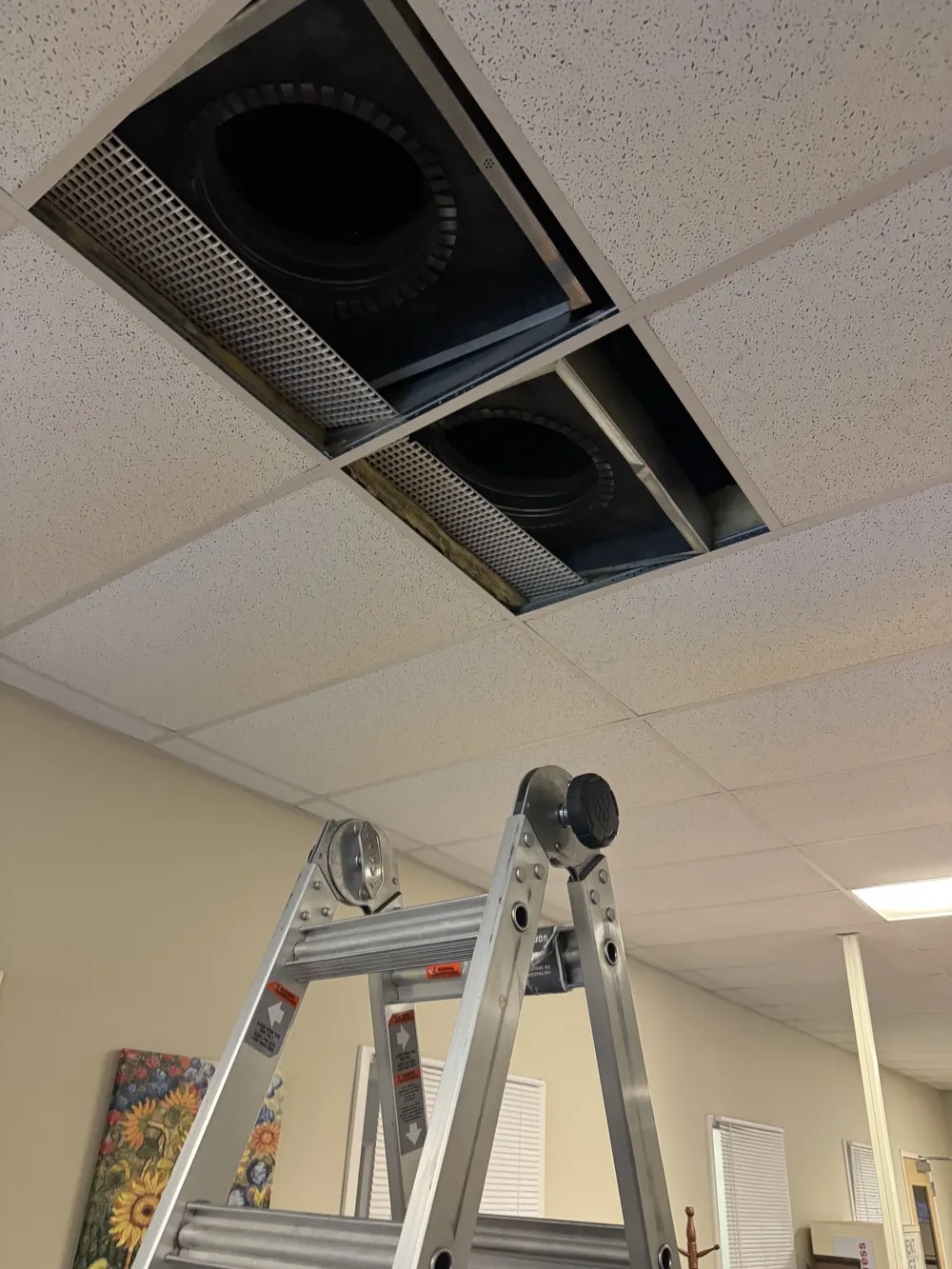
- Visible debris inside ducts spotted during ceiling-tile, cabling, or sprinkler work
- A recent renovation or tenant fit-out that put drywall dust into the return side
None of these automatically means the ducts are the culprit — ventilation rates, filtration, and humidity all play a role in indoor air quality, and duct cleaning is not a cure-all. That is exactly why we start with a free video inspection instead of a sales pitch: the camera either shows meaningful buildup or it does not, and you make the call with the footage in front of you.

How is commercial duct cleaning different from a house call?
The method is identical — source removal with Nikro negative-pressure machines, mechanical agitation, and HEPA filtration, the approach NADCA sets as the industry standard. What changes is everything around the method: longer trunk runs, far more registers per system, ladder work above drop ceilings, ceiling-mounted units, and coordination with your security, alarm, and access procedures. A commercial job is planned like a small project, not a service stop — scoped on camera first, scheduled in writing, and phased so the building keeps running.
How does after-hours scheduling work?
Duct cleaning is loud — the negative-pressure machine runs continuously — and it means open ceiling grid, hoses in corridors, and technicians on ladders. In an operating business, that is disruption you do not need during working hours, so most of our commercial work is scheduled around your calendar rather than ours.
For offices, that usually means evening or weekend windows after tenants leave. Schools book us during summer and holiday breaks, when an entire wing can be done with nobody in the building. Gyms tend to pick their overnight closure or their quietest weekday block. Medical and dental offices schedule after the last patient of the day, and we sequence treatment areas first so they are fully reset well before the next morning's appointments.
Larger buildings are phased zone by zone — one air handler and its territory per visit — so no floor is ever completely out of service and the daytime routine is untouched. Our standard hours are around the clock, Sunday through Friday, and after-hours windows are arranged when you book. For genuinely urgent situations — pest contamination, or renovation debris choking a system ahead of an inspection — we offer 24-hour emergency response (closed Saturdays).
What documentation should you require before work starts?
Any contractor working above your ceiling should be able to produce paperwork before a single tile is lifted. This is the standard package E Cleaning provides on commercial jobs — and roughly what you should demand from anyone bidding against us:
| Document | What it should show | When you get it |
|---|---|---|
| Certificate of insurance (COI) | Active liability coverage — E Cleaning is insured up to $2 million — with your property or management company named as certificate holder on request | Before the crew arrives |
| Contractor license | PA licensed contractor, PA 187935 | With your quote |
| Written scope and price | Which air handlers, trunk lines, and zones are included, the schedule window, and the fixed total | After the free video inspection, before any work |
| Video inspection record | Camera footage from inside the ductwork establishing the before condition | During the inspection visit |
| After-photos | The same duct sections photographed after cleaning, for the building's maintenance file | At the completion walkthrough |
The before-and-after record matters more in commercial work than anywhere else. It closes the loop on tenant complaints — here is what was in the ductwork, here it is removed — it goes into the maintenance file for owners and future managers, and it establishes a baseline the next inspection can be compared against. Our process page walks through how the inspection and after-photo sequence works on every job, residential or commercial.
How much does commercial duct cleaning cost?
Commercial work is quoted per project, and every project starts the same way: with a free video inspection. No two buildings load the same, so the camera sets the real scope — how many air handlers, how long the trunk runs, how heavy the buildup — and that scope becomes a flat, written quote you receive before any work begins. The factors that move a commercial number are practical ones: larger air handlers, longer duct runs, lift and ladder access above drop ceilings, and after-hours labor windows. And because routine cleaning and deep cleaning are genuinely different services, your quote names which one your building actually needs — our air duct cleaning page explains the difference.
Consolidation works in your favor. A building running several rooftop units or air handlers cleaned in one mobilization is meaningfully more efficient than the same units done as separate visits, and your quote reflects that. There are no trip fees anywhere in our service area, and the written number is the number on the invoice — no surprise charges, no door-step upsell. Our pricing page explains how the inspection-first quote works.
How often should a commercial building's ducts be cleaned?
There is no single interval, because the dust load varies enormously by use. An office with good filtration and stable occupancy can go years between cleanings; a gym pushing humid, lint-heavy air through its system all day cannot. The honest answer is inspection-driven scheduling: a periodic camera look inside the ductwork — free, in our case — tells you whether cleaning is warranted or whether the money is better left in the maintenance budget. The same logic we lay out for homes in how often ducts should be cleaned applies here, compressed for heavier use. And after any renovation or tenant fit-out, put a duct inspection on the punch list — construction dust pulled into the return side is one of the clearest-cut cases for cleaning, as we cover in duct cleaning after renovation.
One more system worth putting on the same schedule: if your facility runs laundry — gym towels, salon linens, medical textiles — the dryer vents carry a fire risk that outweighs any air quality concern. Commercial dryers cycling all day pack lint into vent runs far faster than a household machine, and a clogged vent means longer dry times, higher energy use, and genuine fire danger. We clean those too; details are on our dryer vent cleaning page.
Ready to put your building's air system on record?
E Cleaning has been cleaning ductwork in the Philadelphia suburbs since 2016 — family-owned, based in King of Prussia, a PA licensed contractor (PA 187935), and insured up to $2 million, with a COI available before your job starts. We serve commercial facilities across Montgomery, Chester, Bucks, Delaware, Berks, and Philadelphia counties. The first step costs nothing: a video inspection of your ductwork and a written scope you can circulate to ownership.
