
Duct Sanitizing: When It's Necessary and When It's an Upsell
Sanitization is the most quietly profitable add-on in the duct cleaning industry. Done right, it is a legitimate finishing step for a short list of real problems — mold, pest contamination, stubborn odors. Done the coupon-company way, it is a fog of something unnamed sprayed over dust that was never removed, priced per vent until a $49 special becomes a several-hundred-dollar afternoon. This guide covers both versions, so you can say yes or no with confidence before anyone is standing in your basement.
What is duct sanitizing, exactly?
Duct sanitizing is the application of an antimicrobial product — usually fogged or sprayed — onto the interior surfaces of your ductwork after the system has been physically cleaned. The cleaning removes dust, debris, and buildup; the sanitizer then treats the freshly cleaned metal to address what a vacuum and brush cannot: microorganisms and odor sources that remain on the surface itself.
Two phrases in that definition carry all the weight: "after the system has been physically cleaned" and "EPA-registered," which we will get to next. Sanitizing removes nothing. No dust, no debris, no nesting material, no mold colonies — removal is the cleaning's job, done under negative pressure with agitation tools, a method we break down in our guide to source removal duct cleaning. Sanitizing is a surface treatment for ducts that are already clean, and that is the only context in which it earns its price.
At E Cleaning, sanitization is an optional add-on, applied with EPA-registered products, and only ever after the physical cleaning is complete. If your ducts warrant it, it appears on the flat, written quote you receive before any work begins — not something invented in your hallway.
What does "EPA-registered" mean, and why should you insist on it?
Under federal pesticide law, any product sold with sanitizing or disinfecting claims must be registered with the EPA before it can be marketed, and its label legally defines where and how it may be used. Registration means the agency has reviewed the product for use according to that label. It is not a magic certificate, and it is not an endorsement of duct cleaning — it is the baseline that separates a real product with real directions from a mystery jug in the back of a van.
When any company — ours included — proposes sanitizing your ducts, three requests are completely reasonable. Ask for the product name in writing, so you can look up its EPA registration and label yourself. Ask whether the label covers use inside HVAC systems and how the product is supposed to be applied. And decline ozone "shock treatments" in an occupied home; ozone is a lung irritant, and blasting it through ductwork is not the same thing as applying a registered product according to its directions.
One more honest note belongs here. The EPA does not endorse routine duct cleaning as a proven fix for indoor air quality, and adding a sanitizer does not change that. What cleaning and sanitizing can do is remove buildup and treat contamination that is demonstrably there — mold growth, droppings, odor at its source. No company should promise health outcomes from either step, and we do not.
When is duct sanitizing actually necessary?
The legitimate trigger list is short, and every item on it involves something identifiable — not a vague promise of "fresher air." These are the situations where we recommend the add-on on real jobs:
- Confirmed mold growth — after the growth and the dust it fed on are physically removed, treating the cleaned surfaces is the sensible finishing step
- Rodent, bird, or insect contamination — droppings, urine, and nesting material leave residue and odor behind even after the debris itself is extracted
- A musty or animal odor that survives cleaning — when the smell lives on the duct surfaces rather than in the removable debris
- Sensitivity after serious household illness — some families want the air path treated as an extra measure; that is a reasonable choice, not a medical necessity, and we present it that way
- Ducts that have been wet — after a leak or flooding, once everything is dried and cleaned; note that soaked porous duct liner needs replacement, not treatment
- Move-ins with a strong odor history — a previous household with heavy indoor smoking or many pets can leave ductwork that benefits from treatment after cleaning
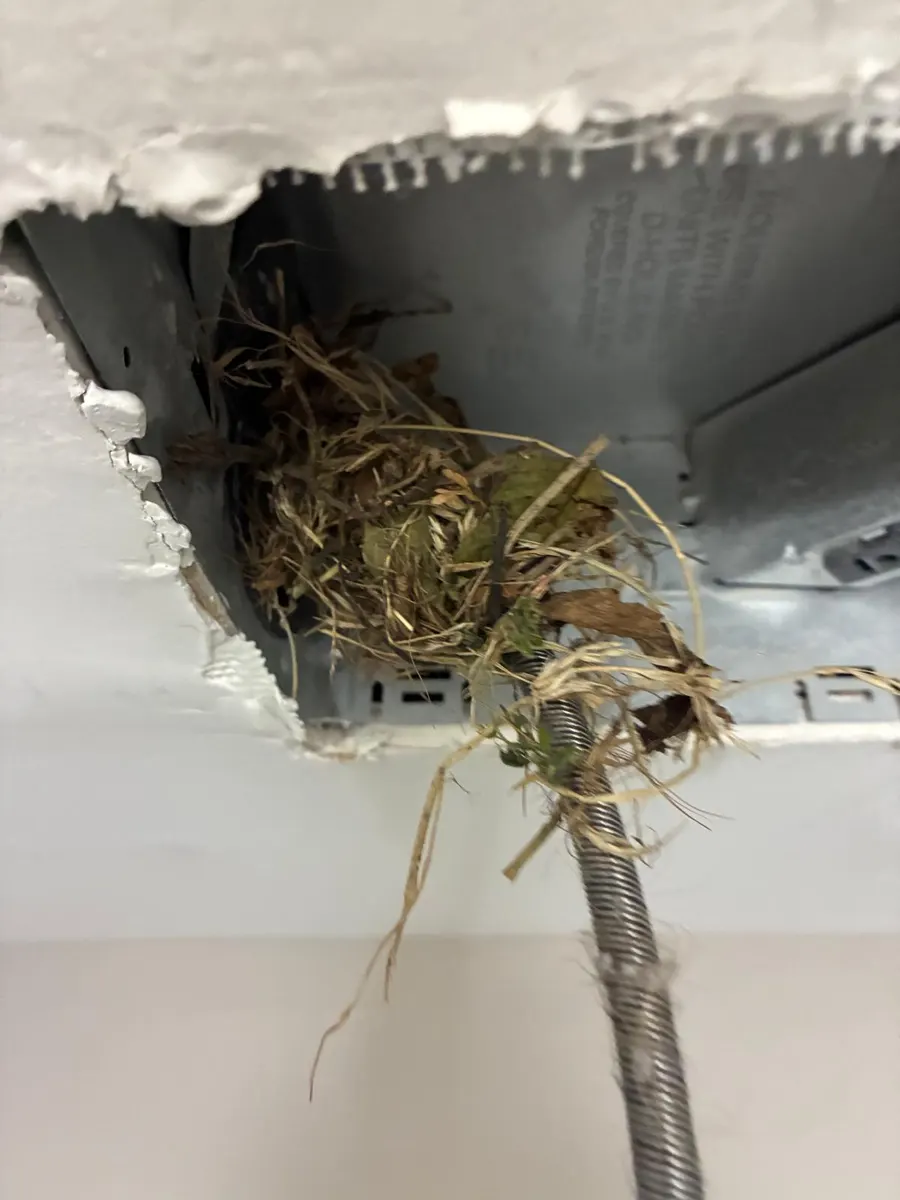
Pest contamination is the clearest case on the list. The photo above is from a real job: nesting material pulled out of a duct run. Extraction gets the debris out, but the surfaces the animals lived on are exactly what EPA-registered sanitizers exist for. If we find this on your video inspection, the recommendation will come with footage, not a lecture about toxic air.
If what the camera shows instead is mold-like growth, start with our guide on what to do about mold in air ducts — the removal-first sequence matters even more there.
Why should sanitizing never be sold instead of cleaning?
Because the product only works on surfaces it can actually reach. Sanitizer labels direct application to cleaned surfaces — spray one over a duct lined with years of dust and you have treated the top of the pile, while the reservoir of debris underneath, and everything living in it, stays exactly where it was. The fog dissipates; the problem does not.
That is why the sequence is fixed: inspect first, remove second, sanitize last. Every E Cleaning job starts with a free video inspection inside the ducts, so you see what is actually in there before anyone quotes anything — the full sequence is on our process page. Then comes the air duct cleaning itself: professional Nikro negative-pressure machines put the duct runs under vacuum while air whips and agitation tools scrub the buildup loose, and HEPA filtration captures what comes out. Only then, on clean metal, does a sanitizer have the surface it was designed for.
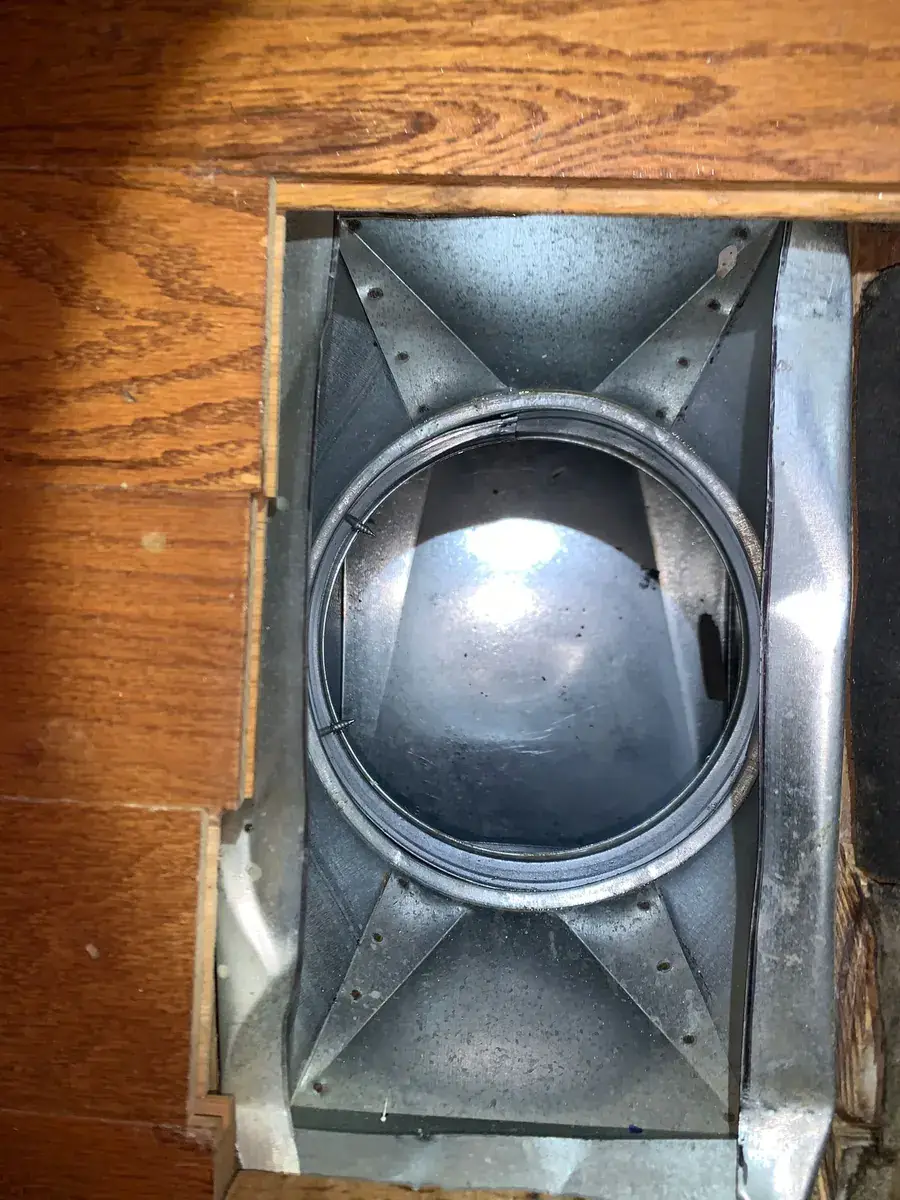
The trunk line above has just been cleaned — this is the condition a sanitizing product is registered to be applied to. Any company willing to fog your system without getting it to this state first is selling you the step that smells like progress while skipping the one that is progress.
How does the sanitizing upsell work at coupon companies?
The playbook is consistent because it works. A $49–$99 "whole house special" gets a crew through the door — a price that cannot cover an hour of honest labor, which is your first clue that the advertised service is not the actual product. Inside, a flashlight sweep of one return produces an alarmed diagnosis: mold, bacteria, "contamination." Then comes the rescue: a sanitizing or deodorizing "treatment," priced per vent or per system, and suddenly the coupon visit is quoted in the hundreds. We took apart the whole routine in our breakdown of the $49 duct cleaning special.
Two tells give the upsell version away every time. First, it is sold instead of real cleaning — a quick fog through the registers while the dust stays put, because actually cleaning the system would destroy the economics of the coupon. Second, nobody can tell you what is in the sprayer. No product name, no label, no answer to whether it is registered for HVAC use. Pair that with an instant mold diagnosis — no photos, no camera footage, no lab — and you are watching a sales script, not an inspection.
The legitimate version looks different at every step: the cleaning and the add-on are spelled out in a flat, written quote before any work begins, the product has a name you can look up, the treatment happens after source removal, and declining it does not change the price of the cleaning you agreed to.
When is it fine to say no to sanitizing?
Most of the time, honestly. The most common duct condition we find is ordinary dust and debris buildup — no growth, no pests, no odor. In that case, source-removal cleaning is the complete service; there is nothing left on the metal for a sanitizer to address, and we will not talk you into one. Here is the decision in one view:
| Situation | Sanitize? | Why |
|---|---|---|
| Confirmed mold growth in the duct runs | Yes — after removal | Treats the cleaned surfaces once the growth and the dust it fed on are gone |
| Rodent, bird, or insect contamination | Yes | Droppings and nesting leave residue and odor that extraction alone may not resolve |
| Musty or animal odor that survives cleaning | Usually | Odor sources sitting on the duct surface respond to treatment on clean metal |
| Recent serious illness, or occupants with severe allergies or asthma | Reasonable option | A measured extra step some families choose — peace of mind, not a promised health outcome |
| Ordinary dust buildup — no odor, growth, or pests | Usually not | The cleaning itself removes the problem; there is nothing left to treat |
| Offered instead of physical cleaning | Never | Sanitizers are registered for use on clean surfaces; fogging over dust fixes nothing |
If allergies are the reason you are considering the add-on, it is worth reading our piece on air duct cleaning and allergies first — the honest picture is that removal does the heavy lifting, and sanitizing is a supporting step in specific cases, not an allergy cure.
How is duct sanitizing priced at E Cleaning?
Every job starts with a free video inspection inside your ducts. Based on what the camera actually shows, you receive a flat, written quote — for the air duct cleaning and, only if your situation calls for it, the sanitizing add-on — before any work begins. The number on that quote is the number on your invoice: no trip fees anywhere in our service area, no door-step upsell, no surprise line items invented in your hallway. Routine cleaning and deep cleaning are scoped honestly as different services, so you always know exactly which one you are getting. Many customers also add dryer vent cleaning while the crew is on site, and financing is available through Wisetack if you would rather spread the cost out.
E Cleaning is family-owned and has served Montgomery, Chester, Bucks, and Delaware counties since 2016. We are PA licensed (PA 187935), insured up to $2 million, and Google Guaranteed with money-back protection up to $2,000 on qualifying jobs. Every job ends with after-photos — and if the camera shows plain dust and nothing more, we will tell you the cleaning is all you need.
