
The Homeowner's HVAC Filter Guide: MERV Ratings Made Simple
Your HVAC filter is the cheapest, highest-leverage air quality tool in your house — and the rating system on the box seems designed to confuse you. MERV, MPR, FPR, "micro allergen defense," numbers running anywhere from 1 to 2800 depending on which scale the brand invented. This guide cuts through it: what MERV actually measures, which rating fits your home, when to change the filter, why a filter can be too strong for your system, and where filters end and duct cleaning begins. One note up front — we clean ducts for a living, but filters are something you buy at the hardware store, not from us. There is no upsell here.
What Does a MERV Rating Actually Mean?
MERV stands for Minimum Efficiency Reporting Value. It is a standardized test scale developed by ASHRAE, the engineering body that writes HVAC standards, and it runs from 1 to 16 for the filters sold for homes and commercial buildings. The test measures how well a filter captures particles in three size ranges: large particles of 3 to 10 microns (pollen, dust mite debris, carpet fiber), medium particles of 1 to 3 microns (finer dust, some pet dander), and small particles of 0.3 to 1 micron (smoke, smog, and particles in the size range of many bacteria). The higher the MERV number, the smaller the particles the filter is required to capture in meaningful amounts.
Here is the mental shift that makes everything else in this guide click: MERV is not a quality grade. A MERV 13 filter is not "better made" than a MERV 8 the way a more expensive tire is better made. It is a different point on a tradeoff dial — more capture on one side, more airflow resistance on the other. Denser media catches smaller particles, and denser media also makes your blower work harder to pull air through it. Picking a filter is picking where on that dial your home and your equipment should sit.
One more decoder-ring note before the recommendations. Big-box brands often skip MERV on the front of the box in favor of their own scales — 3M uses MPR (Micro-Performance Rating, running into the thousands), and Home Depot house brands use FPR (a 1-to-10 scale). These are marketing scales for the same underlying physics. The fine print on the packaging almost always lists a MERV equivalent; find it and compare filters on MERV so you are comparing one standard, not three.
Which MERV Rating Should You Use at Home?
For most houses, MERV 8 is the sensible default, MERV 11 is the right upgrade for homes with pets or mild allergies, and MERV 13 is the practical ceiling for a typical residential system — worth it for allergy and asthma households or smoke concerns, but only if your system can handle it. Here is the full picture:
| MERV rating | What it captures | Best for | Watch out for |
|---|---|---|---|
| MERV 6–7 | Larger dust, lint, pollen, dust mite debris | Bare-minimum equipment protection | Does little for the finer particles people actually breathe |
| MERV 8 | Everyday household dust, pollen, mold spores | Most homes without pets or allergy issues | Pet dander and smoke mostly pass through |
| MERV 11 | Adds pet dander, finer dust, vehicle exhaust particles | Homes with pets, mild allergies, nearby traffic | Slightly more airflow resistance; change on schedule |
| MERV 13 | Adds smoke, smog, bacteria-sized particles, and droplets that can carry viruses | Allergy or asthma households, wildfire smoke season | Real strain on some systems in a 1-inch size — see below |
| MERV 14–16 | Hospital-grade filtration territory | Purpose-built systems with dedicated filter cabinets | Most residential blowers are not designed for this resistance |
What about MERV 14 and above?
Skip them, unless an HVAC contractor has specifically set your system up for it. Ratings above 13 are the territory of hospitals and clean rooms, and the pressure they put on a standard residential blower — especially through a thin 1-inch filter rack — creates the airflow problems described later in this guide. If someone in your home has a medical reason to want that level of filtration, the better paths are a dedicated media filter cabinet installed at the furnace or a portable HEPA unit running in the bedroom. Both deliver high capture without suffocating your ductwork.
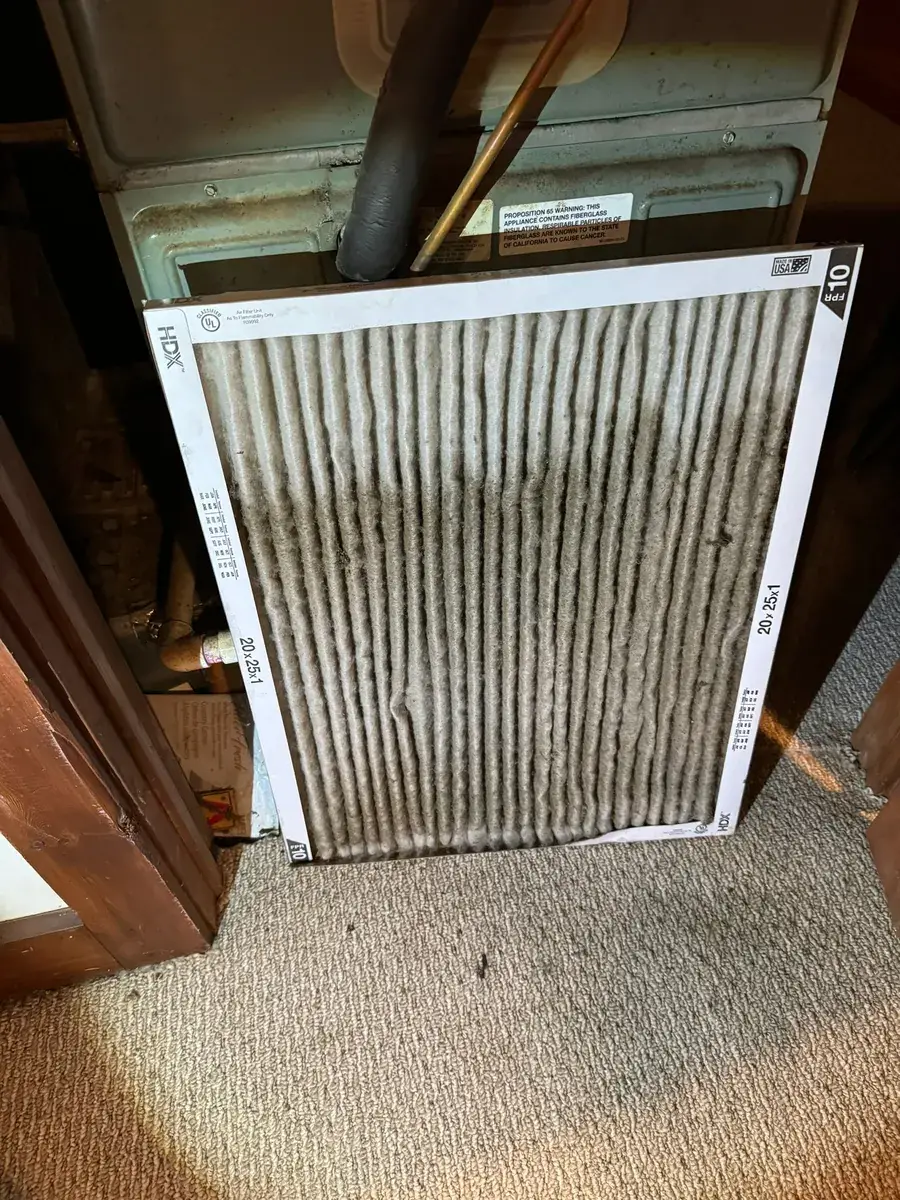
The filter above came out of a working system during one of our inspections, and it is a perfect picture of what the industry calls filter loading. As a filter runs, captured dust builds into a grey mat across the media. Counterintuitively, a lightly loaded filter actually captures a bit better than a fresh one — the dust cake itself traps particles. But resistance climbs the whole time, and past a point the loaded filter chokes airflow, strains the blower, and starts letting air sneak around its edges instead of through it. A filter in the condition photographed here stopped being a filter a long time ago; it is a wall. This is why the change interval matters as much as the MERV number on the box.
How Often Should You Change Your HVAC Filter?
Change standard 1-inch filters every 1 to 3 months, and deep-pleated 4-to-5-inch media filters every 6 to 12 months. Where your home lands inside those ranges depends on how hard the filter works: shedding pets, allergy-season pollen, a full house, and peak summer or winter run time all push you toward the short end. A one-person condo with hard floors can stretch a 1-inch filter to 90 days; a family home with two dogs in July usually cannot make it past 30.
Rather than trusting the calendar alone, check the filter monthly — it takes ten seconds. Pull it and hold it up to a light. If light passes through evenly, reinstall it. Change it now if any of the following is true:
- You cannot see light through the media. A solid grey mat means the filter is loaded and restricting airflow.
- Dust is collecting on the return grille. Buildup on and around the grille means the system is moving more dust than the filter is keeping up with.
- Airflow from supply registers feels weak. A choked filter is the first and cheapest suspect for a system that suddenly seems underpowered.
- The system runs longer to hit the thermostat setting. Restricted airflow makes every heating and cooling cycle work harder and cost more.
- You just finished renovation or drywall work. Fine construction dust loads a filter in days, not months. Change it immediately after the work wraps, whatever the calendar says.
- You cannot remember when you last changed it. If the date is a mystery, the filter is overdue. Write the install date on the frame from now on.
Can a Filter Be Too Strong for Your System?
Yes — over-filtering is a real and common problem, and it is the reason "just buy the highest number" is bad advice. Your blower was engineered to move a certain volume of air against a certain amount of resistance, called static pressure. A dense high-MERV filter raises that resistance, and it keeps raising it as the filter loads with dust. Push resistance past what the blower was designed for and the symptoms show up all over the house: weak airflow at the registers, whistling or rattling around the filter rack as air gets sucked through gaps, an air conditioner coil that ices over from starved airflow, longer run times, higher utility bills, and premature wear on the blower motor.
The thickness of the filter matters as much as its rating. A 1-inch MERV 13 filter has to do all of its fine filtering in a single thin layer, which makes it dense and restrictive. A 4-inch MERV 13 media filter accomplishes the same capture with several times the pleated surface area, so air passes through it far more easily. Same MERV, very different load on the system. If your furnace has a 1-inch filter slot and you want MERV 13, it can work on many modern systems — but change it monthly, watch for the symptoms above, and back down to MERV 11 if they appear. If you want high filtration without the strain, ask an HVAC contractor about installing a media filter cabinet; it is a modest one-time job that upgrades the filter slot itself.
One related trap: stretching the interval on a "premium" filter. A loaded MERV 8 can restrict airflow worse than a fresh MERV 11, so a neglected cheap filter and an over-ambitious expensive one end up causing the same problem. Whatever rating you choose, the change schedule is not optional.
Do Better Filters Replace Duct Cleaning?
No — and the reverse is also true. Filters and duct cleaning do different jobs on different clocks, and homeowners get the best results treating them as partners rather than substitutes. Your filter works on air that is passing through it right now: it protects the blower and coil and captures circulating particles, month after month. What it cannot do is touch anything upstream of it or anything that has already settled. Every bit of dust, pet hair, and debris pulled into a return grille travels the full length of the return ductwork before it ever reaches the filter, and plenty of it settles along the way. Add the air that leaks around ill-fitting filter frames and through duct seams, and you have material accumulating in places no filter will ever see.
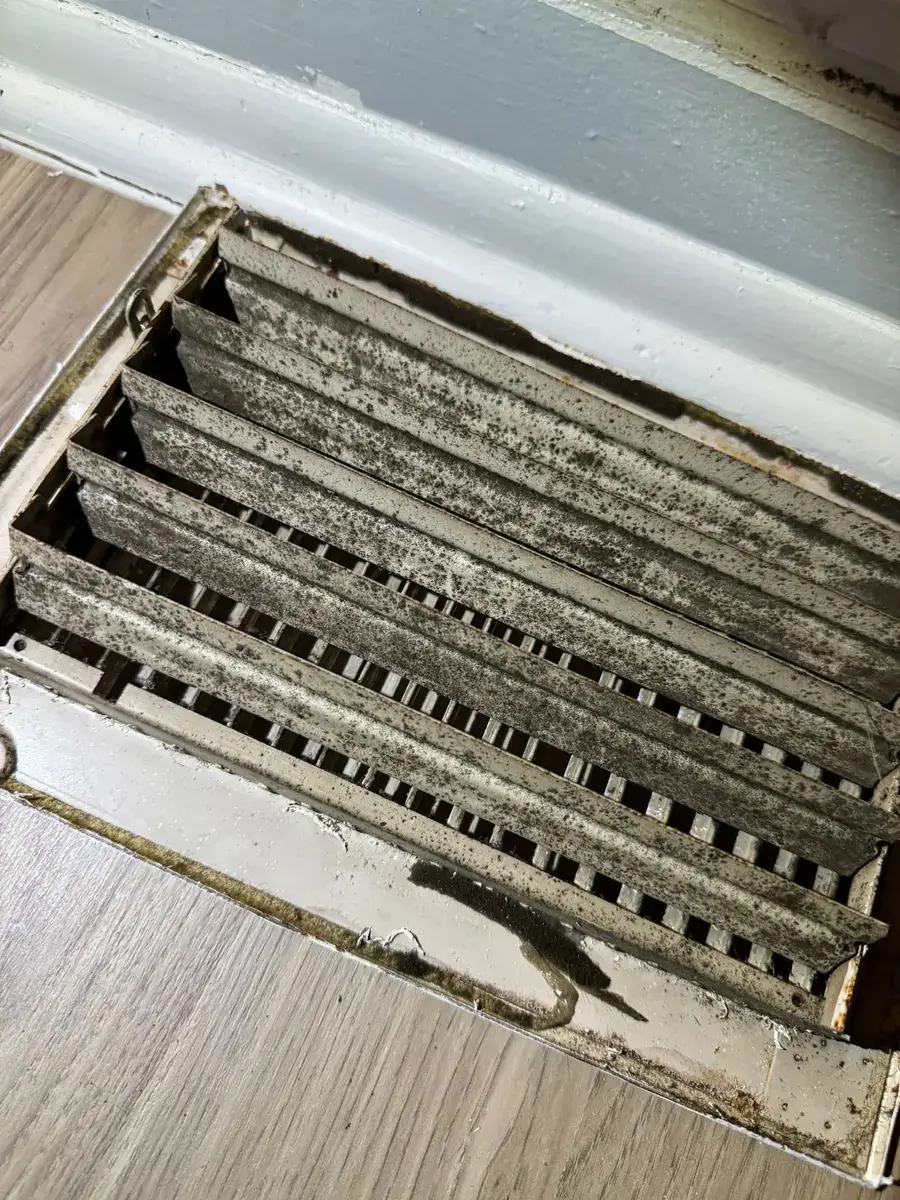
The return duct above shows exactly what "upstream of the filter" means — that buildup accumulated in a home where a filter was installed and running the entire time. Air duct cleaning is the periodic reset that removes what has settled through the whole duct network; a good filter then slows down how fast it comes back. To be clear about what cleaning does and does not do: it can help reduce the dust and dander recirculating through the system, and many homeowners notice less settling dust afterward — but the U.S. EPA does not endorse routine duct cleaning as a proven fix for indoor air quality, and neither do we. It is clearly warranted when there is visible mold, heavy debris, pest evidence, or renovation dust; otherwise most homes only need it every 3 to 5 years. Our guides on how often ducts should be cleaned and the signs your ducts actually need it cover how to tell where your home stands, and if lower utility bills are your goal, read our honest take on duct cleaning and energy bills — the filter change is usually the bigger lever.
How Do You Buy and Install the Right Filter?
Five minutes of care at the hardware store and the filter rack saves you every problem in this guide. Here is the whole routine:
Find your size
The size is printed on the frame of the current filter, like 16x25x1. That is the nominal size; if the old filter is missing or fits sloppily, measure the slot itself, because a filter that leaves gaps lets dirty air bypass it entirely.
Pick your MERV
MERV 8 as the default, 11 for pets or mild allergies, 13 for asthma, allergy, or smoke concerns if your system tolerates it. If the box only shows MPR or FPR, check the fine print for the MERV equivalent.
Point the arrow the right way
Every filter frame has an airflow arrow. It points in the direction the air moves — toward the furnace or air handler, away from the return duct. Backwards filters load unevenly and can bow into the rack.
Date it and stock up
Write the install date on the frame in marker and set a phone reminder. Buy a multipack so a spare is always sitting next to the furnace — the filter you have on hand is the one that gets changed on time.
Where Does Professional Cleaning Fit In?
Filters are your job; the ductwork behind them is ours. E Cleaning is a family-owned company serving Montgomery, Chester, Bucks, and Delaware counties since 2016, PA licensed (PA 187935), insured up to $2 million, and Google Guaranteed. Every job starts with a free video inspection inside the ducts — and that inspection cuts both ways. If the camera shows clean ductwork because your filter habits have been doing their job, we will tell you so and you keep your money. If it shows the kind of buildup photographed above, you get a flat, written quote before any work begins — no trip fees anywhere in our service area, no surprise invoice, no door-step upsell — and you can see exactly how a visit works on our process page.
One last filter worth mentioning is the one in your laundry room. Your dryer's lint screen is a filter too, and like your HVAC filter it only catches most of what passes through — the rest builds up in the vent line year after year, where the failure mode is not dusty air but fire. Dryer vent cleaning is a quick once-a-year job, and like every job we do it starts with that same free video inspection and a written quote up front.
