
The Pet Owner's Guide to Air Ducts and Dander
Anyone who has peeled a grey mat of fur off a floor register knows pets and ductwork have a complicated relationship. Every return vent in your home inhales whatever floats past it — and in a house with a shedding dog or a pair of cats, that means fur, dander, and litter dust, all day, every day. This guide covers how fast pet households really load their ducts, the cleaning interval that fits a multi-pet home, a filter strategy that actually works, and the grooming habits that keep the whole system cleaner between professional visits.
How do pet fur and dander get inside air ducts?
Your HVAC system pulls household air through its return vents over and over, all day long — and returns sit exactly where fur travels. Floor and wall returns live at ankle height, along baseboards, in the hallways where pets nap, so they collect hair the way a vacuum nozzle would, just slower and around the clock. Every time the blower starts, the mat on the grille gets tugged a little further inward.
Fur is only the visible half of the problem. Dander — the microscopic flakes of skin that all cats and dogs shed constantly — is the half you cannot see. Dander particles are small and light enough to stay airborne for hours, slip past a basic fiberglass filter, and settle throughout the supply runs, where the next heating or cooling cycle stirs a portion back into your rooms. As a rule of thumb: fur mats on return grilles and filters, while dander travels deep into the system.
The scale surprises people. Industry sources such as Stanley Steemer estimate the average six-room home can accumulate 40 pounds of dust in a year — and that figure describes a typical household before you add a double-coated dog blowing its undercoat every spring and fall.
How often should air ducts be cleaned in a home with pets?
There is no official schedule, but the guidance most companies give — every three to five years for a typical home — assumes a typical dust load, and pets change that math. With one short-haired, low-shedding pet, the standard interval usually holds. With two or more shedding pets, every two to three years is more realistic, and heavy shedders, indoor grooming, or a family member with allergies can shorten it further. Our full guide to how often air ducts should be cleaned walks through the other variables.
Condition beats the calendar, though. Watch for these signs that your pet household is running ahead of schedule:
- Fur visible inside returns when you lift a floor grille or unscrew a wall grille
- Filters grey and matted within two or three weeks of a fresh install
- Dust rings around supply registers that come back soon after wiping
- Fur tumbleweeds re-forming within a day or two of vacuuming
- A pet odor in the first minutes after the heat or AC kicks on
- Allergy symptoms consistently worse indoors than outside
Two or more of these together usually mean the duct system is carrying a real fur-and-dander load, whatever the calendar says. For photo examples of the broader warning signs, see our guide to the signs your air ducts need cleaning.
What MERV filter rating is best for homes with pets?
For most pet households, a MERV 10–11 filter is the sweet spot: fine enough to catch a meaningful share of dander, not so restrictive that it strains a standard residential blower. Fur is the easy part — almost any filter stops hair. Dander is the real filtration challenge, because the particles are far smaller and stay airborne far longer.
| Filter rating | What it handles | Fit for a pet home |
|---|---|---|
| MERV 6–8 | Dust, lint, pet hair, larger particles | Baseline. Workable for one low-shedding pet if changed monthly; most dander gets through |
| MERV 10–11 | Finer dust plus a good share of pet dander | Best balance for most pet households — meaningful dander capture without heavy airflow restriction |
| MERV 13 | Even finer particles, including smoke and more dander | Strongest residential filtration; confirm your blower is rated for it before switching |
Two practical notes. First, check your system's documentation — or ask your HVAC tech — before jumping to MERV 13. A high-resistance filter on a blower that was not designed for it can reduce airflow and stress the equipment. Second, pet homes wear out filters faster than the packaging assumes: a one-inch filter marketed as a 90-day filter often mats over in three to four weeks in a two-dog house. Check it monthly, and if you find yourself replacing it constantly, ask about a 4- or 5-inch media filter cabinet, which holds far more dust and dander between changes.
One thing no filter can do is clean what is already downstream of it. The filter treats air on its way to the equipment; the fur and dander that settled in your supply runs over the past several years stay there until they are physically removed.
Does grooming actually keep your air ducts cleaner?
Yes — every brushful of fur collected outdoors is fur that never reaches a return vent. Grooming is the cheapest duct-maintenance tool a pet owner has, because it works at the source instead of chasing hair around the house.
The habits that make the biggest difference: brush shedding pets outdoors a few times a week, and daily during the spring and fall coat-blow if you have a double-coated breed. Bathe dogs on the schedule your vet recommends — bathing loosens dander as well as fur. Vacuum pet zones with a HEPA-equipped vacuum a couple of times a week, and run the brush attachment over the return grilles themselves while you are at it, since a fur mat on the grille migrates inward every time the blower starts. Wash pet bedding, throws, and couch covers regularly; fabric is where dander concentrates. And if you have cats, keep the litter box well away from any return vent — airborne litter dust is a duct-loading source most owners never think about.
None of this replaces cleaning, but it stretches the interval between professional visits — and it means the cleaning you do book stays clean noticeably longer.
What does a fur-loaded return actually look like?
The photos below were taken on real jobs in Pennsylvania homes, not staged for marketing. This is what technicians find when they open up returns and pull filters in households with pets.
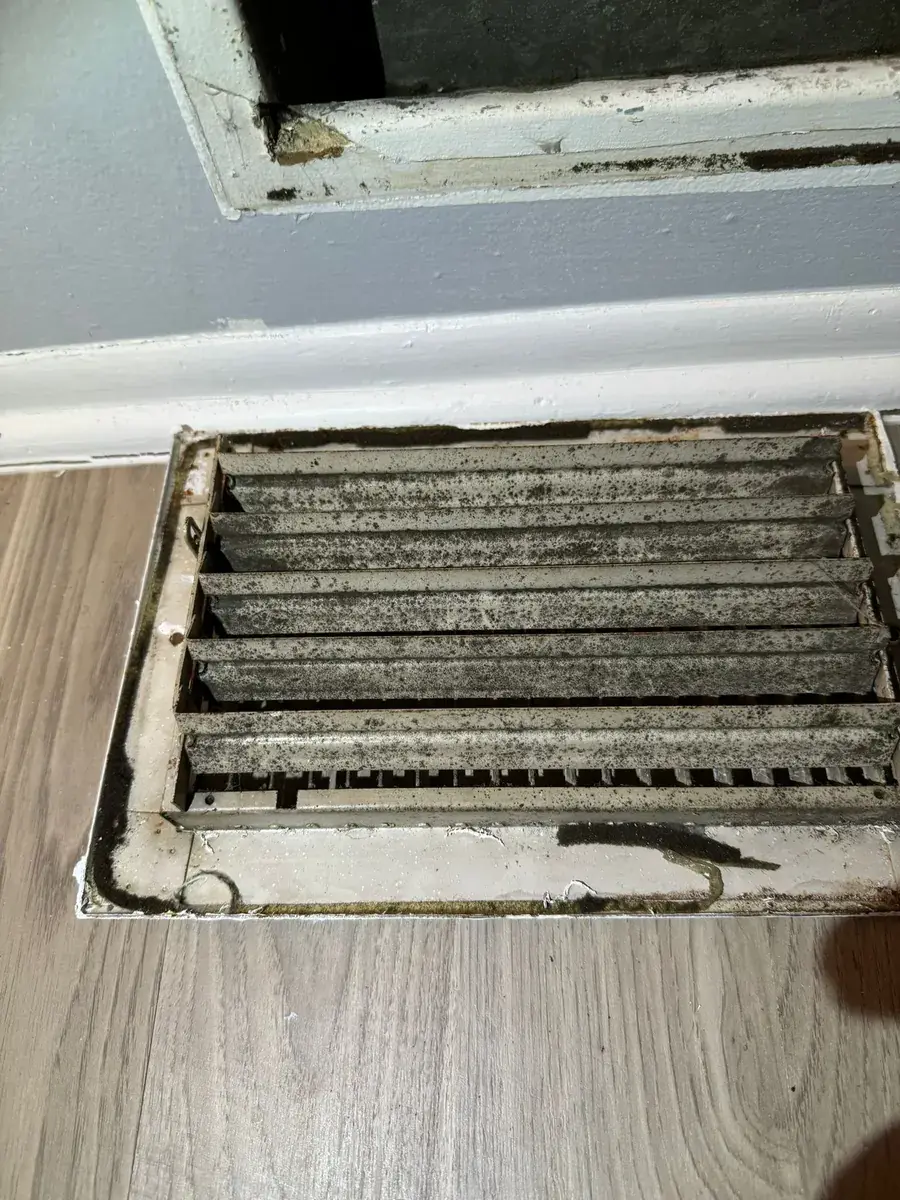
Floor returns are the classic pet-home picture: a felt-like mat of hair, dust, and carpet fibers sitting just below the grille, with more packed into the duct boot underneath. Because a return is always pulling air inward, the mat keeps compacting and growing until someone physically removes it — it never blows itself clear.
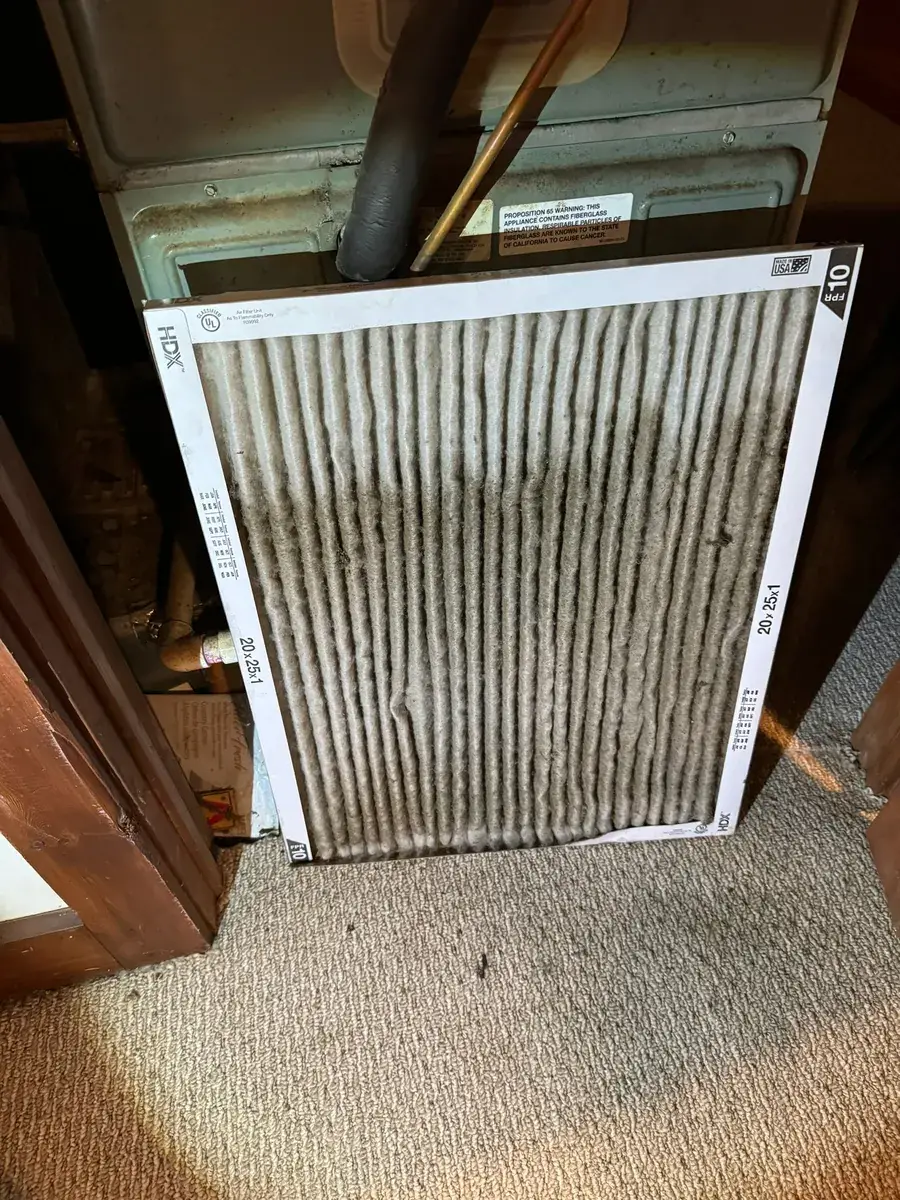
Filters tell the rest of the story. A filter this loaded is doing its job — but it is also proof of how much material the return side is carrying, and everything that slipped past it earlier is now sitting in the ducts. Before any work begins, we run a free video inspection inside your ductwork and show you exactly what your system is holding, then take after-photos when the job is done. You can read how a visit works, step by step, on our process page. If the camera shows your ducts are actually clean, we will tell you that instead of selling you a cleaning you do not need.
Can duct cleaning help with pet allergies?
It can help reduce the reservoir of settled dander your system recirculates, and many homeowners with pet allergies notice a difference — but honest expectations matter more here than anywhere else in this guide.
Two caveats keep this honest. The EPA does not endorse routine duct cleaning as a proven fix for indoor air quality problems, so be wary of any company promising your allergies will disappear. And dander is produced fresh every day your pet lives with you — no cleaning is permanent. What duct cleaning does is remove years of accumulated fur and dander from the air path so the blower stops redistributing it, which lowers the particle load your filter, and your sinuses, have to handle. Cleaning is clearly warranted when there is visible debris, mold, or pest activity in the system. For lingering pet odor in the ductwork, sanitization with EPA-registered products is available as an add-on, applied after the physical cleaning is done — if the video inspection shows it makes sense for your system, it goes on the same written quote before any work begins.
Why do pet owners need dryer vent cleaning more often too?
Pet hair follows the laundry. Fur works into bedding, blankets, towels, and clothes; the washer releases it, and the dryer's lint screen catches only part of what comes off in the tumble. The rest rides the exhaust into the vent line, where hair and lint knit together into dense mats that cling to the duct wall — pet hair makes lint buildup faster and more stubborn than lint alone.
That buildup is a genuine fire issue, not just a nuisance. According to NFPA data from 2010–2014, U.S. fire departments respond to an estimated 15,970 home fires involving clothes dryers or washing machines each year, and failure to clean is the leading factor, contributing to one-third (33%) of dryer fires. If your loads have started taking longer than they used to, our article on why clothes take two cycles to dry explains what is happening inside the vent.
We handle dryer vent cleaning too, and most pet households bundle it with the duct cleaning while the equipment is already set up — it gets scoped in the same free video inspection and lands on the same flat, written quote. For the full safety picture, see our dryer vent fire safety guide.
What does air duct cleaning cost for a pet household?
It works the same whether you have zero pets or five: every air duct cleaning starts with a free video inspection inside your ductwork, and you get a flat, written quote before any work begins — no trip fees anywhere in our service area, no surprise invoice, no door-step upsell. Routine cleaning and deep cleaning are honestly scoped as different services, so a fur-loaded system gets quoted for the work it actually needs, in writing, up front. Every job includes cleaning with professional Nikro negative-pressure machines and agitation tools — the approach NADCA sets as the industry standard — and after-photos when we finish, with financing available through Wisetack.
E Cleaning is family-owned, founded in 2016, PA licensed (PA 187935), insured up to $2 million, and Google Guaranteed with money-back protection up to $2,000 on qualifying jobs. We serve Montgomery, Chester, Bucks, and Delaware counties plus Berks and Philadelphia from our King of Prussia base, around the clock, Sunday through Friday. If the fur tumbleweeds are winning, we can help.
